Check If Used Car Sold at Auction: Complete Guide

Here's something most car buyers don't realize: the majority of used cars on dealer lots came from auctions.
That "certified pre-owned" sedan? Probably bought at Manheim last month. The "one-owner" SUV? Could have passed through Copart after an insurance claim. The pristine luxury car with a "clean history"? Might have auction photos showing damage you'll never see on Carfax.
When you check if used car sold at auction, you discover the vehicle's true condition and what the dealer actually paid—information that can save you from overpaying or buying hidden damage.
This guide shows you exactly how to check if used car sold at auction using the VIN.
Check If Used Car Sold at Auction
VinPassed shows complete auction records—sale dates, prices, photos, and condition reports. See what the dealer saw before they bought it.
View Sample Report →Why You Should Check If Used Car Sold at Auction
Not all auction history is bad. Many perfectly good cars pass through dealer auctions as lease returns, trade-ins, or fleet vehicles. But when you check if used car sold at auction, you discover:
- What the dealer paid: Auction records show the actual sale price—useful for negotiating
- What condition it was in: Auction photos capture the vehicle before any reconditioning
- Whether it was damaged: Salvage auctions document total losses and major damage
- How many times it's been resold: Multiple auction appearances can indicate problems
- The real timeline: When it sold, where, and to whom
A car that went through a clean dealer auction at wholesale value is very different from one that was totaled, sold at salvage auction, repaired, and flipped to retail.
Types of Auctions You’ll Find When You Check If a Used Car Sold at Auction
Understanding the different auction types helps you interpret what the history means when you check if a used car sold at auction:
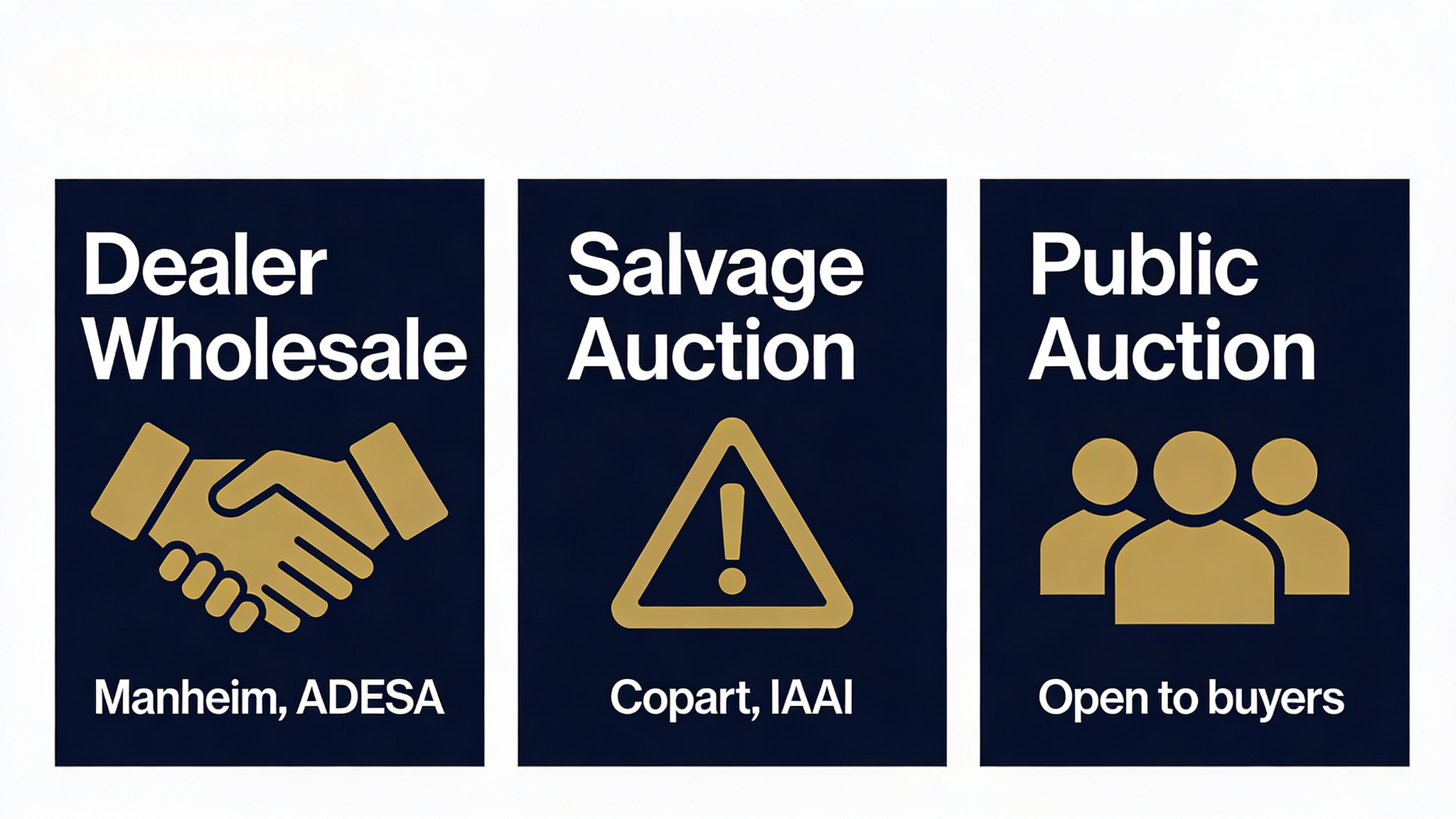
Red Flag: Salvage Auction History
If you check if used car sold at auction and it appears in Copart or IAAI records, it was likely an insurance total loss. This doesn't automatically mean it's unsafe, but it requires extra scrutiny. The auction photos will show exactly why it was totaled. Learn more about salvage titles.
How to Check If Used Car Sold at Auction by VIN
Standard vehicle history reports (Carfax, AutoCheck) don't include auction data. Here's how to actually check if used car sold at auction:
- Get the VIN Find the 17-character Vehicle Identification Number on the dealer's listing, the dashboard (visible through windshield), or door jamb sticker.
- Run a VinPassed Report VinPassed specifically pulls auction records from Copart, IAAI, Manheim, and other major auction houses. You'll see sale dates, prices, condition notes, and photos.
- Review the Auction Details If auction history exists, examine the sale date, price, and any damage notes. Compare to the current asking price.
- Look at the Auction Photos This is the most valuable part. Photos show the vehicle's actual condition when it sold—before any repairs or reconditioning.
What You Find When You Check If Used Car Sold at Auction
When you check if used car sold at auction and find history, VinPassed provides:
Auction Data Included:
- Sale date and location: When and where the auction occurred
- Auction type: Dealer wholesale, salvage, or other
- Sale price: What the dealer actually paid
- Primary damage: The main issue (if any) documented at auction
- Secondary damage: Additional damage notes
- Odometer reading: Mileage at time of auction
- Title status: Clean, salvage, rebuilt, etc.
- Photos: Typically 8-15 images showing all angles and damage
- Repair estimate: Estimated cost to repair (for damaged vehicles)
What If You Check If Used Car Sold at Auction and Find Nothing?
If you check if used car sold at auction and VinPassed shows no records, the vehicle likely:
- Was a direct trade-in: Previous owner traded it at a dealership that kept it for retail
- Came from a private sale: Dealer purchased directly from an individual
- Is a lease return: Sold directly from manufacturer to dealer
- Was dealer-transferred: Moved between dealerships in the same group
No auction history isn't inherently good or bad—it just means you can't use auction data for price verification or condition documentation. You'll need to rely more on the standard vehicle history and a physical inspection.
Pro Tip
Even if you check if used car sold at auction and find no records, a VinPassed report still shows title records, accident history, theft records, and dealer listing history. You may also see repair estimates and damage records from other sources.
Red Flags When You Check If Used Car Sold at Auction
When you check if used car sold at auction and review the records, watch for these warning signs:
Multiple Auction Appearances
If a car has been through auction multiple times, buyers keep rejecting it. There's usually a reason—mechanical problems, title issues, or hidden damage that becomes apparent after purchase.
Salvage Auction Origin
Copart and IAAI sell insurance total losses. A car from salvage auction may be perfectly repairable, but you need to verify the repairs were done properly. The auction photos will show the original damage extent—check for structural damage specifically.
Recent Auction Sale
If the auction sale was within the past 30-60 days, the dealer has barely had time to recondition it. Quick flips sometimes mean minimal repairs and maximum markup.
Price Discrepancy
Compare auction sale price to current asking price. A reasonable dealer markup is 15-25%. If they paid $12,000 at auction and want $22,000, that's an 83% markup—a red flag, especially on a vehicle with any damage history.
Damage Listed But "Clean Carfax"
Auction records may show damage that never made it to Carfax. If auction photos show significant damage but the Carfax is clean, the accident was never reported through normal channels. This is how dealers hide accident history.
Using What You Learn When You Check If Used Car Sold at Auction
When you check if used car sold at auction, the records give you powerful negotiating leverage:
- You know their cost: The auction price is what the dealer paid. Everything above that is markup plus reconditioning.
- You see what they saw: Dealers review auction photos before bidding. Now you have the same information.
- You can justify your offer: "I see you paid $14,000 at Manheim in November. I'm willing to pay $17,000, which gives you a fair profit."
Dealers respect informed buyers. Showing up with auction data signals you've done your homework and aren't going to overpay.
Protect Your Purchase
Once you've checked if used car sold at auction, verified the history, and negotiated a fair price, protect your investment with appropriate warranty coverage.
Vehicles that came through auction—especially salvage auction—can have underlying issues that surface later. VIP Warranty covers vehicles up to 250,000 miles with no mileage cap once enrolled, including vehicles with auction history that other warranty companies reject.
Check If Used Car Sold at Auction: The Bottom Line
Most used cars pass through auction at some point. When you check if used car sold at auction and see the photos and sale prices, you're on equal footing with the dealer.
A $29.99 VinPassed report can reveal:
- Whether the car was at auction (and which type)
- What the dealer actually paid
- Photos showing the condition before reconditioning
- Damage and repair estimates
- How many times it's been resold
That's information worth having before you negotiate—or walk away.
Check If Used Car Sold at Auction
VinPassed Report — $29.99
Auction records • Sale prices • Photos • Complete history
Check Any VIN Now →Check If Used Car Sold at Auction: FAQ
Do all used cars go through auction?
Not all, but a significant majority do. Dealer auctions are the primary way dealerships acquire and dispose of inventory. Trade-ins that don't fit a dealer's market often go to auction, and most lease returns pass through auction before reaching retail lots.
Is it bad if I check if used car sold at auction and find records?
Not necessarily. Dealer wholesale auctions (Manheim, ADESA) handle millions of clean vehicles annually. What matters is the type of auction and the condition at sale. Salvage auctions require more scrutiny than wholesale auctions.
Can I check if a used car sold at auction for free?
Some limited data is available through free VIN checkers, but comprehensive auction records—including photos and sale prices—typically require a paid report. Free services rarely include the visual documentation that makes auction history valuable.
Does Carfax let me check if a used car sold at auction?
Carfax may show that a vehicle was "sold at auction" as an ownership event, but they don't include auction photos, sale prices, or detailed condition reports. To fully check if a used car sold at auction with complete data, you need a service like VinPassed that specifically pulls auction records. See our Carfax vs AutoCheck comparison for details on what each service shows.
What if I check if used car sold at auction and find salvage records?
Salvage auction history means the vehicle was likely declared a total loss by an insurance company. Review the auction photos carefully to understand the damage extent. Have a mechanic inspect the repairs before purchasing. It's not automatically a deal-breaker, but requires extra due diligence.