What Dealer Paid for Car: How to Find the Real Number

Every car dealer knows exactly what they paid for the vehicle they're selling you. They know their cost, their target profit margin, and how low they can actually go.
You're negotiating blind. They're not.
That information asymmetry is how dealers make money. But here's the thing: you can find out what dealer paid for car and completely change the negotiation dynamic.
This guide shows you how to discover what dealer paid for car, what markup is reasonable, and how to use this information to negotiate thousands off the asking price.
⚡ Before You Negotiate: Do These First
- Check the title before anything else. A $4.99 quick check confirms the title is clean and the vehicle hasn't been reported stolen. Takes 30 seconds and applies toward a full report if you upgrade.
- Get what dealer paid for car. A $9.99 auction report shows the actual auction sale price and pre-repair photos. This is your primary negotiating number.
- Run the full report before you visit. The complete VinPassed report ($29.99) adds market values, repair estimates, listing history, and AI risk score on top of dealer cost. Know everything before you sit down.
- Know your legal rights before you sign. Used car buyer protections vary dramatically by state. Our state-by-state used car buyer protection guide covers what recourse you have if something goes wrong after purchase.
Find What Dealer Paid for Car
VinPassed shows the actual auction sale price, what dealer paid for car before they marked it up for retail. Knowledge is negotiating power.
See a Sample Report →Where Dealers Get Their Used Car Inventory
Before you can find what dealer paid for car, you need to understand where used cars come from:
Trade-Ins
Customers trade in their old vehicle when buying a new one. The dealer gives them a trade-in value (usually below market) and either keeps the car for their lot or sends it to auction.
Dealer Auctions
The majority of used car inventory comes from wholesale auctions like Manheim, ADESA, and regional auction houses. These are dealer-only auctions where vehicles sell at wholesale prices, and where you can discover what dealer paid for car.
Salvage Auctions
Some dealers buy damaged vehicles from Copart or IAAI, repair them, and resell at retail. This is where the biggest markups often hide. Check for salvage title history before buying.
Lease Returns
Off-lease vehicles go to auction or get sold directly to dealers. These are often well-maintained with documented service history.
The key insight: Most used cars have an auction record somewhere. That record shows exactly what dealer paid for car. Learn how to check if a used car sold at auction.
How to Find What Dealer Paid for Car
Here's the step-by-step process to uncover what dealer paid for car:
Step 1: Get the VIN
Every vehicle has a 17-character Vehicle Identification Number. Get it from the listing, the dashboard (visible through windshield), or ask the dealer directly.
Step 2: Run an Auction History Report
Standard vehicle history reports (Carfax, AutoCheck) don't show what dealer paid for car. You need a service that specifically pulls auction data.
VinPassed reports include:
- Actual auction sale price (what dealer paid for car)
- Auction date and location
- Condition at time of sale
- Estimated repair costs (if applicable)
- Photos from the auction showing pre-repair condition
You can get just the auction data for $9.99 with the VinPassed Auction Report, no full report required. If no records are found, your $9.99 applies toward the full $29.99 report.
Step 3: Calculate the Markup
Compare the auction price to the asking price. The difference between what dealer paid for car and the sticker price is their gross margin before reconditioning costs.
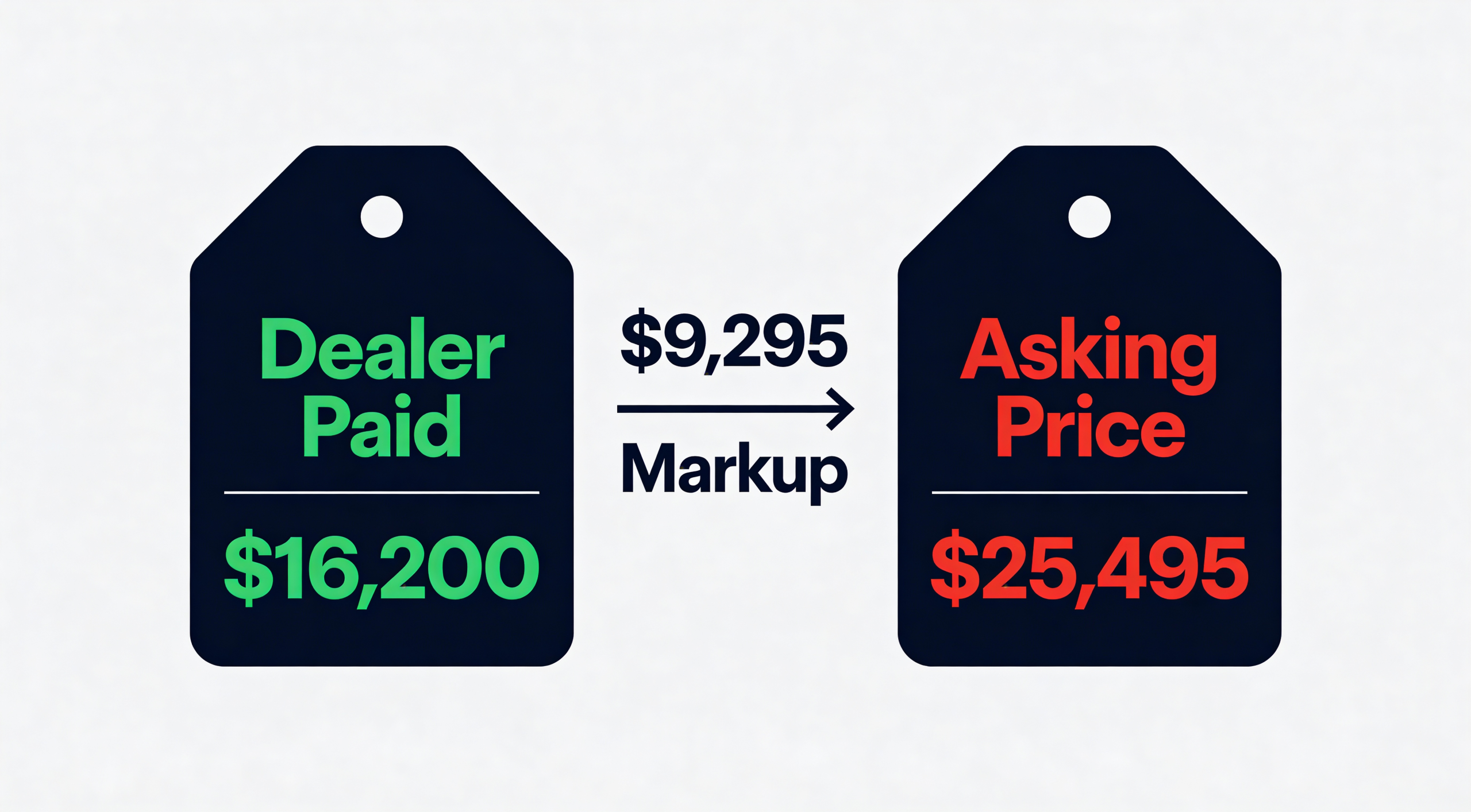
What Dealer Paid
$16,200
Asking Price
$25,495
$9,295 Markup (57%)
What’s a Normal Dealer Markup?
Dealer profit margins vary widely based on the vehicle and where they sourced it:
| Source | Typical Markup | Notes |
|---|---|---|
| Clean trade-in | 15-25% | Lower risk, known history |
| Dealer auction (clean) | 20-30% | Standard wholesale-to-retail margin |
| Lease return | 15-25% | Usually well-documented |
| Salvage auction (repaired) | 40-70%+ | High risk, high margin |
A 20-30% markup on a clean vehicle is standard business. A 50%+ markup, especially on a vehicle with auction damage history, is a red flag worth investigating before you commit.
Watch for Salvage Flips
Dealers who buy damaged cars at salvage auction, repair them, and sell at retail often have the highest markups. They might pay $12,000 for a damaged vehicle, spend $3,000 on repairs, and list it for $22,000. VinPassed shows you this entire chain including the pre-repair auction photos. This is one way dealers hide accident history.
How to Use What Dealer Paid for Car to Negotiate
Knowing what dealer paid for car changes everything. Here's how to use it:
1. Establish Your Target Price
A reasonable offer is what dealer paid for car plus 15-20% for margin and reconditioning. If they paid $16,000, an offer of $18,500-$19,000 is fair and still profitable for them.
2. Don't Reveal Your Knowledge Immediately
Let the salesperson make their pitch. Ask what flexibility they have on price. See how low they'll go on their own before you play your card.
3. Use the Data Strategically
Once they've given their "best price," you can reference what dealer paid for car:
Sample Negotiation Script
"I've done my research on this vehicle. I can see it sold at auction in March for $16,200. I understand you need to make a profit, but $25,000 is a 55% markup. I'm prepared to pay $19,000 today, which gives you a fair margin. Can we make that work?"
4. Be Prepared to Walk Away
If the dealer won't negotiate reasonably despite knowing you have the data, walk away. There are other cars and other dealers. The listing history in a VinPassed report also tells you how long they've been sitting on this car, a vehicle that's been on the lot 90 days with two price drops is a dealer under pressure.
Pro Tip
Bring a printed VinPassed report to the dealership. Physical evidence is more powerful than saying "I looked it up online." It shows you're serious and informed. See more negotiation tactics.
What If You Can’t Find What Dealer Paid for Car?
Not every used car goes through auction. If VinPassed shows no auction history, the vehicle was likely:
- A direct trade-in: Customer traded it in and dealer kept it for retail
- A private purchase: Dealer bought directly from a private seller
- A lease return: Sold directly from manufacturer to dealer
In these cases, you can still estimate dealer cost using wholesale value guides (like Manheim Market Report or Black Book), but you won't have the exact number for what dealer paid for car.
The VinPassed report still shows you accident history, title issues, dealer listing history, and other valuable data, even without auction records. And a $4.99 title and stolen check is always worth running before handing over any money regardless of whether auction data exists.
Real Example: Using What Dealer Paid for Car to Save $3,500
Here's how knowing what dealer paid for car works in practice:
A buyer found a 2019 Honda Accord listed at $24,500. The dealer claimed it was "priced to sell" with "no room to negotiate."
The VinPassed report showed what dealer paid for car:
- Sold at Manheim auction 6 weeks prior for $18,200
- No accidents reported
- Clean title
- Single previous owner
Armed with the information about what dealer paid for car, the buyer countered at $20,500, a fair price that still gave the dealer roughly $2,300 gross profit after reconditioning.
The dealer initially pushed back, but when shown the auction data, agreed to $21,000. That's $3,500 saved because the buyer knew what dealer paid for car.
Other Benefits of Knowing What Dealer Paid for Car
Identify Overpriced Inventory
If a dealer is asking 50%+ over what dealer paid for car on a vehicle with no special features, they're testing the market for uninformed buyers. Move on to a more reasonably priced option.
Spot Potential Problems
A suspiciously low auction price often indicates problems, damage, high mileage, or title issues. The VinPassed report shows the full context including auction photos of any damage documented before reconditioning.
Understand Dealer Motivation
If a car has been on the lot for 60+ days and the dealer paid top dollar at auction, they may be motivated to deal. Their floor plan interest is eating into profit every day the car sits.
After You Negotiate: The Free Garage That Comes with Every Report
Knowing what dealer paid for car gets you to a fair purchase price. What happens after the purchase matters just as much. Every VinPassed report, including the $9.99 auction report, unlocks a free permanent garage for that vehicle.
VinPassed Garage, Free with Every Report
Your Vehicle's Permanent Home Base After Purchase
More data than fits in any report. Free for life. Add every vehicle you own.
🔧 Maintenance Schedule
Exact service intervals for your specific trim. See what's completed, overdue, and coming up. Updates with your mileage.
💰 Repair Cost Lookup
Searchable parts-and-labor estimates before you go to the shop. Know what any repair should actually cost.
🛡️ Safety Recalls
Live NHTSA recall tracking ongoing. Open recalls flagged as they're issued, not just at purchase.
📋 Technical Service Bulletins
Known manufacturer-acknowledged problems for your specific model, what dealers might not volunteer.
🚗 Full Specifications
Complete powertrain, dimensions, fuel economy, every factory option for your exact configuration.
📁 Document Storage
Upload insurance, registration, and service receipts, encrypted and private. Tracked service history boosts resale 15-20%.
🔓 Currently free with every report. Premium features are coming including an AI concierge that tracks your driving patterns and tells you exactly when service is due. The free tier is permanent.
Protect Your Purchase: Legal Rights and Coverage
Knowing what dealer paid for car gets you to a fair price. But two things are worth knowing before you sign anything:
Know your state's used car buyer rights. Most buyers have no idea what legal protections they have if something goes wrong after purchase. Some states have mandatory cooling-off periods, no-intent fraud standards, and mandatory attorney fees if a dealer misrepresented the vehicle. Others allow nearly all "as-is" sales with minimal recourse. Our state-by-state used car buyer protection guide scores all 50 states across 36 components so you know exactly where you stand. If you purchased a new vehicle that turned out to be defective, our 50-state lemon law guide covers what remedies are available, and our lemon law calculator can help you assess your situation.
Consider ongoing mechanical protection. Many buyers who purchase vehicles that came through auction worry about long-term reliability, especially if the car had any reported issues. VIP Warranty covers vehicles up to 250,000 miles with no mileage cap once enrolled. Their exclusionary coverage includes virtually all mechanical components, giving you peace of mind regardless of where the dealer sourced the vehicle.
What Dealer Paid for Car: The Bottom Line
Dealers have always had an information advantage. They know what dealer paid for car, what it's worth, and how much margin they're making.
Now you can know too.
A VinPassed report costs $29.99 and shows you what dealer paid for car at auction. That single piece of information can save you thousands in negotiations and protect you from overpaying for problem vehicles. Or start with the $9.99 auction report to get just the dealer cost and pre-repair photos, and upgrade if you want the complete picture.
Before you finalize any deal, also take two minutes to check what used car buyer protections your state provides. Knowing what dealer paid for car is your negotiating tool. Knowing your legal rights is your safety net.
Stop negotiating blind.
Find What Dealer Paid for Car
VinPassed Report, from $9.99
Auction prices · Dealer cost · Pre-repair photos · Full history · Free permanent garage
Check Any VIN Now →What Dealer Paid for Car: Frequently Asked Questions
Can I find out what dealer paid for car on any vehicle?
If the vehicle went through a wholesale or salvage auction, yes. VinPassed pulls auction records showing what dealer paid for car, including the sale date, location, and condition. Vehicles that were direct trade-ins or private purchases won't have auction records, but you can estimate using wholesale guides like Manheim Market Report or Black Book.
Is it rude to tell a dealer I know what dealer paid for car?
No. It's business. Dealers negotiate with informed buyers every day, and most respect it. Being direct about your research typically leads to faster, more honest negotiations than dancing around pricing. Bring a printed copy of the VinPassed report, physical evidence carries more weight than "I looked it up."
What if the dealer says my information about what dealer paid for car is wrong?
Auction records are documentation of actual transactions, they're factual data points, not estimates. If a dealer claims the data is wrong, ask them to show you their purchase documentation. In most cases they'll drop the objection and start negotiating on price rather than disputing the record.
Does Carfax show what dealer paid for car?
No. Carfax shows accident history, service records, and title information, but not what dealer paid for car at auction. This omission is intentional, Carfax's primary customer is the dealer, not the buyer. You need a service specifically designed to pull auction sale data, like VinPassed. See our Carfax vs AutoCheck comparison for a full breakdown of what each service includes.
What's a fair profit margin for a dealer?
15-25% on clean vehicles is standard, this covers reconditioning, floor plan financing costs, overhead, and profit. Markups over 40% should raise questions, especially if the vehicle has any history issues or has been sitting on the lot for an extended period. A 57% markup like the example above is worth negotiating hard on.
What if there is no auction record showing what dealer paid for car?
Not every used car goes through auction. Trade-ins, private purchases, and lease returns may have no auction record. In these cases, estimate dealer cost using wholesale value guides. VinPassed still shows accident history, title issues, listing history, and other useful data even without auction records. And a $4.99 title and stolen check is always worth running before handing over any money.
Can I get just the auction data showing what dealer paid for car without a full report?
Yes. VinPassed's $9.99 Auction Report shows what dealer paid for car at auction plus pre-repair photos, without requiring a full report. If no auction records exist, your $9.99 applies toward the full $29.99 complete report, so you're not starting over.
How long before my visit should I find out what dealer paid for car?
Before you visit, not after. Running the report before your test drive means you walk onto the lot already knowing the dealer's acquisition cost, the vehicle's auction condition, and any red flags. It also tells you whether the trip is worth making, if the auction photos show significant undisclosed damage, you've saved yourself a wasted visit and a potentially uncomfortable negotiation.
Does knowing what dealer paid for car work at every dealership?
It works at any dealership that sourced inventory through auction, which is the majority of used car dealers. Franchise dealers buying from manufacturer auctions, independent dealers buying from Manheim or ADESA, and salvage flippers buying from Copart or IAAI all leave auction records. The only cases where it doesn't apply are direct trade-ins and private purchases that never went through a public auction.
What legal protections do I have if a dealer misrepresented the vehicle?
Your rights depend heavily on your state. Most states have UDAP (Unfair and Deceptive Acts and Practices) statutes that provide real remedies if a dealer knowingly misrepresented the vehicle, including mandatory attorney fees and punitive damages in some states. Some states also have implied warranty protections that survive as-is language. Our state-by-state used car buyer protection guide covers what's available where you live. If you purchased a new vehicle that turned out to be defective, our lemon law calculator can help you assess your options.
Is knowing what dealer paid for car enough, or do I need the full report?
Dealer cost is your most powerful negotiating number, but it's one piece of the picture. The full VinPassed report adds market values showing what the car is worth from multiple angles, repair cost estimates if there's documented damage, listing history showing how long and how desperately the dealer has been trying to sell, and a free permanent garage with ongoing maintenance and recall tracking. For a $28,000 purchase, the additional $20 over the $9.99 auction report is trivial insurance.
What do dealers know that buyers typically don't?
Quite a bit. When a dealer buys at auction, they receive a condition report and detailed photos of the car before bidding. They know exactly what they paid. They know which repairs were done before putting it on the lot and which weren't. Buyers typically see a cleaned-up car with a sticker price. VinPassed closes that gap, putting the same pre-purchase information in your hands that the dealer had when they bought the car. See our full breakdown on how dealers control what buyers know.