Can Dealers Hide Accident History? Yes, and Here’s How
Here's a question that should sit with every used car buyer: can a dealer sell you a previously wrecked car while advertising it as accident-free, and stay within the law? The uncomfortable answer is usually yes.
It works because of two things that combine badly for buyers: vehicle history reports are incomplete, and disclosure law in most states only reaches what a dealer can be shown to have known. Put those together and a damaged car can be sold as clean, with the dealer claiming ignorance. Here's exactly how that happens, a real case where it did, and how to catch it before you hand over money.
It starts with the gaps in the report
The foundation of the whole tactic is that a clean report isn't proof of a clean history. A report can only show what was reported to it, and accidents slip through whenever no police report was filed, no insurance claim was made, the repair shop doesn't report, the data hasn't propagated yet, or the car's history crosses state lines. We cover that mechanism in full in why Carfax misses accidents, and Carfax itself acknowledges its data is incomplete.
The point for this article is what dealers do with that gap. A clean report isn't just a happy accident for a seller. For some, it's the product.
The disclosure loophole
Dealer disclosure rules vary by state, but the common thread is this: dealers are generally only required to disclose what they know. If damage isn't on the report and the dealer didn't personally witness it, many will say they "didn't know," even when the evidence was a single auction lookup away. Not looking becomes a defense.
Usually must be disclosed
- Salvage or rebuilt title, in most states
- Flood damage, if the title is branded
- Odometer discrepancies, under federal law
- Known frame damage, in some states
Often not required
- Accidents that never produced a title brand
- Repairs done before the dealer acquired the car
- Damage that was "professionally repaired"
- Auction history and condition reports
The loophole is visible once you line those up: a car can be totaled in one state, repaired, moved through a state with looser titling, and sold as clean, with the dealer claiming they never knew.
A real case: the $25,000 salvage Maserati
This isn't hypothetical. Here's a documented example of every piece working together.
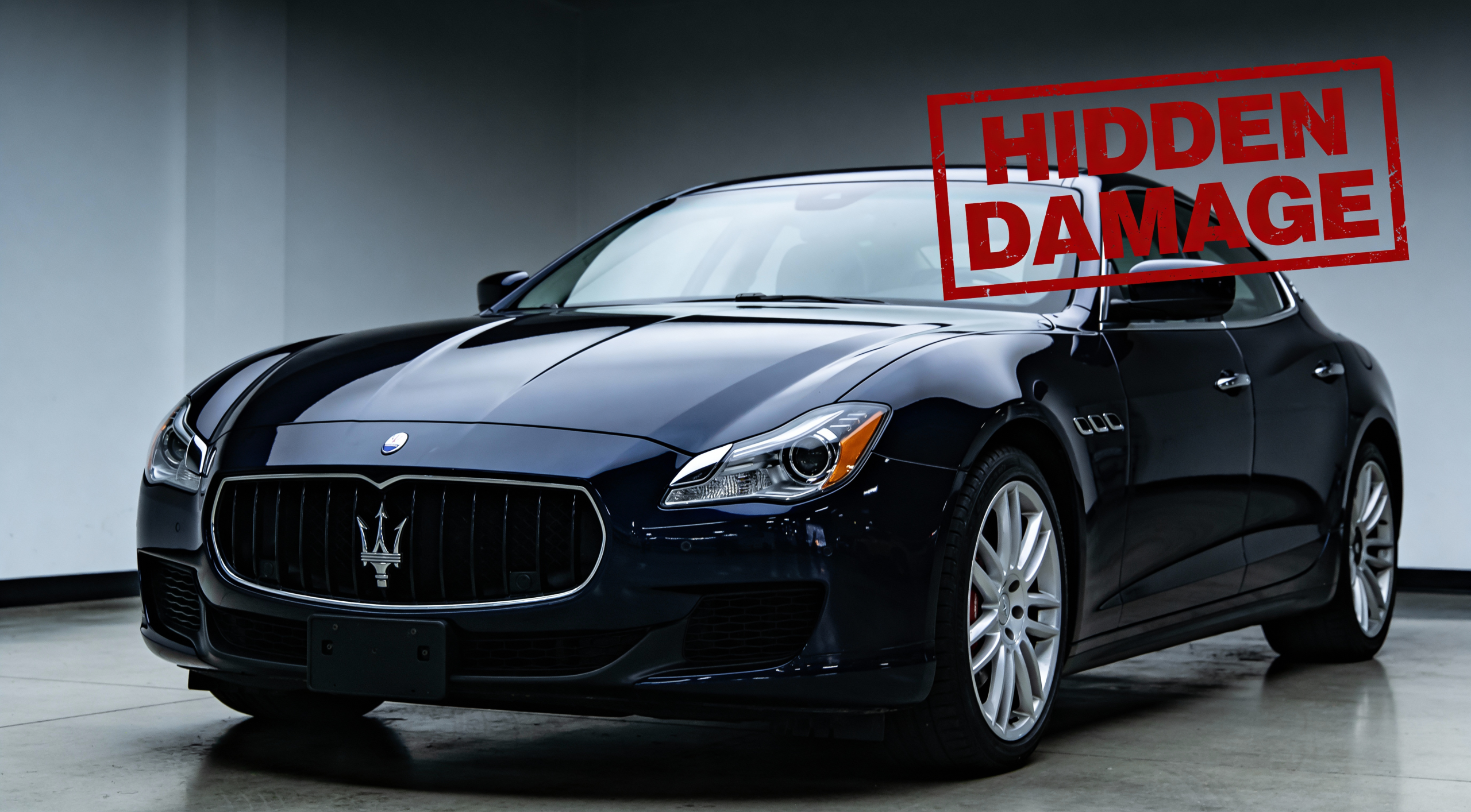
Advertised "no accident damage." The record said otherwise.
The timeline the records told:
- Aug 2018: structural damage reported
- Oct 2020: vehicle reported stolen (theft status is verifiable free at NICB VINCheck)
- Feb 2021: insurer declared a total loss, salvage title issued
- Mar 2021: sold at a Copart auction for about $16,200, with a repair estimate near $25,900
- Mar 2022: listed by a Utah dealer as "NO ACCIDENT DAMAGE" at $25,495
The auction photos showed severe front-end damage, deployed airbags, and damage reaching into the engine compartment, on a car whose repair estimate exceeded its value. It still reached a retail lot advertised as clean. A buyer trusting the listing would have paid a no-damage price for a salvage car, with no idea the dealer had bought it wrecked for two-thirds of the asking price.
The four moves, named
The Maserati wasn't a one-off. The same handful of moves recur.
Title washing
A salvage car is moved to a state with looser titling and re-issued a clean-looking title, erasing the brand on paper. The dealer points to the clean title as cover.
Selective reporting
Run the report that comes back clean, advertise it loudly, and skip the auction-history check that would surface the photos and repair estimates.
Plausible deniability
Because most laws hinge on what's "known," simply not searching for problems lets a dealer claim ignorance. Not looking is the strategy.
"As-is" paperwork
As-is language shifts risk to the buyer, so when problems surface, the dealer points back to what you signed.
How to catch it before you buy
You can't count on a dealer to volunteer what hurts the sale, and you can't count on a clean report to catch everything. So look where the dealer's report doesn't.
- Run an auction-history check. If the car went through Copart, IAAI, or Manheim, there are usually photos and condition notes showing the damage before it was repaired. That's the evidence the listing won't mention, and a report that includes auction data is how you get to it when it exists.
- Cross-reference more than one source. Different databases catch different things; the Carfax vs AutoCheck comparison shows where they diverge.
- Verify the title through NMVTIS. The federal National Motor Vehicle Title Information System consolidates brands across states, which is the main defense against title washing.
- Compare asking price to auction price. If a car sold wrecked at auction for far less than the lot price, the gap tells you what you're really looking at, and gives you room to negotiate or walk.
- Get a pre-purchase inspection. A mechanic spots prior repairs, frame work, and paint that photos can miss.
If it already happened to you
If you discover the damage after buying, your position depends heavily on your state and on what you can prove, so move in order.
- Document everything while it's fresh: the history report, auction photos, the original listing, and what you were told verbally.
- Go back to the dealer first. Some will resolve it rather than face a formal complaint.
- File complaints with your state Attorney General and DMV if the dealer won't engage.
- Consult an auto-fraud attorney. Many work on contingency, and a dealer who had auction records but advertised "clean" may have crossed into misrepresentation.
How strong your hand is comes down to your state's consumer-protection laws, which vary widely. Our state-by-state used car buyer protection guide lays out where you stand, and the honest truth is that knowing this before you sign protects you far better than any step you can take afterward, when the burden to prove it shifts onto you.
The bottom line
Can dealers hide accident history? Yes, and mostly by relying on incomplete reports and claiming they didn't know. Can you catch it? Also yes, if you look where they'd rather you didn't. A clean report is what the dealer shows you. The auction record, the title chain, and the car itself are where the truth usually sits. Get those before you sign, not after.
See what the listing leaves out
The damage a dealer counts on you not seeing usually lives in the auction record.
A free VIN check confirms the basics, and checks start at $5 for a title and stolen check across all 50 states.
Start With a Free VIN Check →Frequently Asked Questions
Common questions about hidden accident damage, disclosure law, and what to do about it.
Often, yes, depending on the state and on what the dealer can claim to have known. Most states require disclosure of salvage or branded titles and some known major damage, but accidents that never made it onto official records sit in a gray area. A dealer who didn't actively look for auction records or damage history can claim they didn't know, and in many states that's enough to stay on the right side of disclosure law even while selling a previously wrecked car as clean.
Title washing is moving a vehicle with a salvage or branded title into a state with different titling rules so it can be re-issued a clean-looking title, erasing the brand from the paperwork. It's against the law but hard to prosecute, and it happens. An NMVTIS-sourced report is the main defense, because the federal database consolidates title-brand data across states and can catch a brand that was issued elsewhere.
They rely on the gaps. A clean report gets advertised prominently, while the auction records that would show the actual damage photos and repair estimates simply don't get run, or don't get shared. Because a report only shows what was reported to it, a car with real but unreported damage can carry a clean history, and a dealer can lean on that without technically lying about the report itself. The full mechanism is in why Carfax misses accidents.
Not always. As-is language shifts a lot of risk to the buyer and makes ordinary disappointment your problem, but it doesn't automatically shield a dealer from a fraud or misrepresentation claim if they actively misstated the car's condition or history. Some states also keep certain implied protections alive despite as-is wording. What you actually have depends heavily on your state, so the paperwork you signed is the start of the question, not the end of it.
Look where the dealer's report doesn't. Run an auction-history check for pre-reconditioning photos and condition notes when the car went through auction, cross-reference more than one history source, verify title history through NMVTIS for signs of state-to-state washing, compare the asking price to what the car sold for at auction if that's available, and get a pre-purchase inspection. The damage a dealer is counting on you not to see usually lives in the auction record or on the car itself, not in the clean report they're showing you.
Document everything first: the report, any auction photos, the listing, and what you were told. Then take it to the dealer, since some will resolve it rather than face a complaint. If that fails, file with your state Attorney General and DMV, and consult an auto-fraud attorney, as many work on contingency. Your leverage depends on your state's consumer-protection laws and on the evidence you preserved. Knowing your state's used car buyer protections before this happens matters more than reacting after. This isn't legal advice.