Carvana VIN Check: What the Free Carfax Doesn’t Show You
Five real buyer stories. One pattern. And the vehicle intelligence that could have changed every outcome.
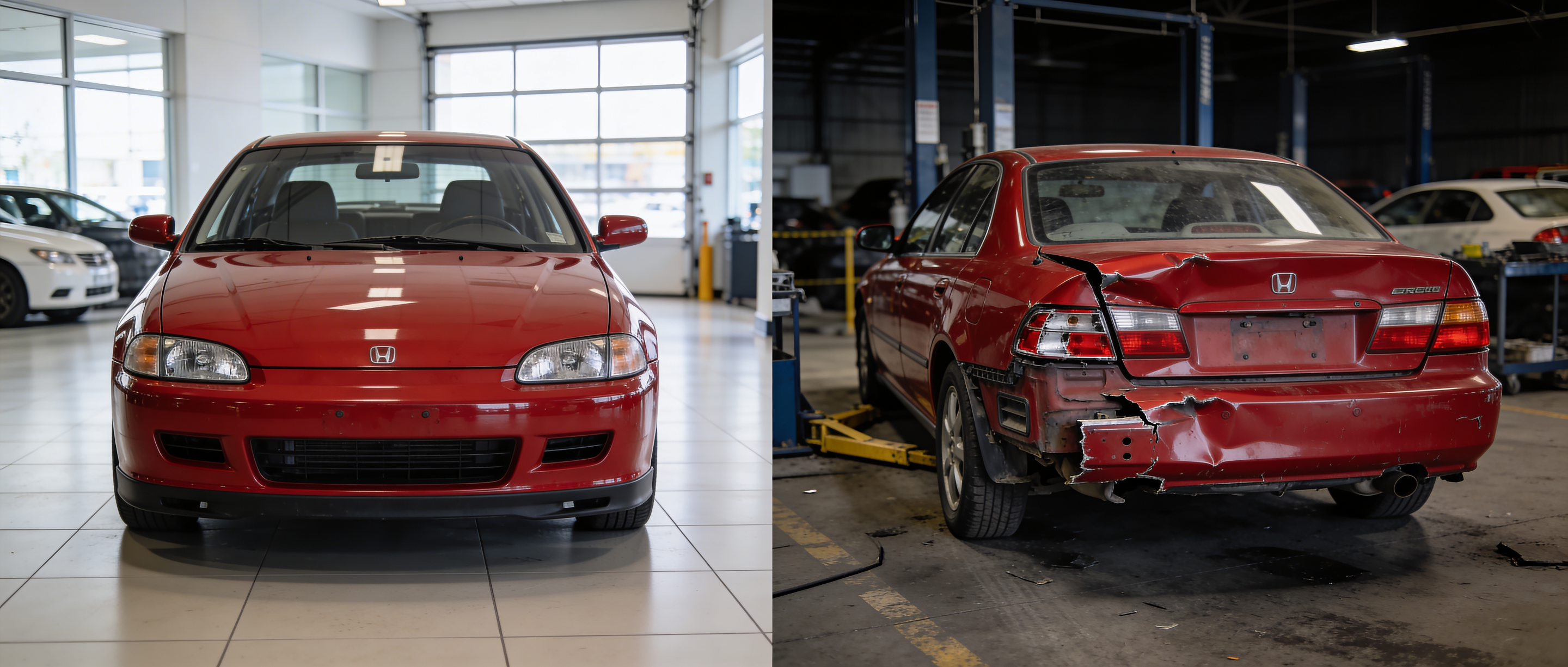
Carvana includes a free Carfax with every listing. That feels like protection. It feels like transparency. And for most buyers, it's enough to click "buy" on a $25,000 car they've never touched.
But a carvana vin check through Carfax only tells you what's been reported. It doesn't tell you what was missed, what was buried, or what's about to go wrong. And the stories of buyers who trusted that free report — then discovered the truth weeks later — follow a pattern that every Carvana shopper needs to understand before they commit.
This isn't speculation. These are documented complaints from real buyers, BBB filings, attorney general investigations, and court cases — all pointing to the same gap between what buyers are told and what they actually get.
In This Article
- Eric's Carvana Vin Check. The Clean Carfax That Wasn't Clean
- Rebecca and the Buyback Guarantee That Guaranteed Nothing
- Marcus Paid $38,000 for an Undisclosed Wreck
- The Day 8 Problem: When the 7-Day Window Slams Shut
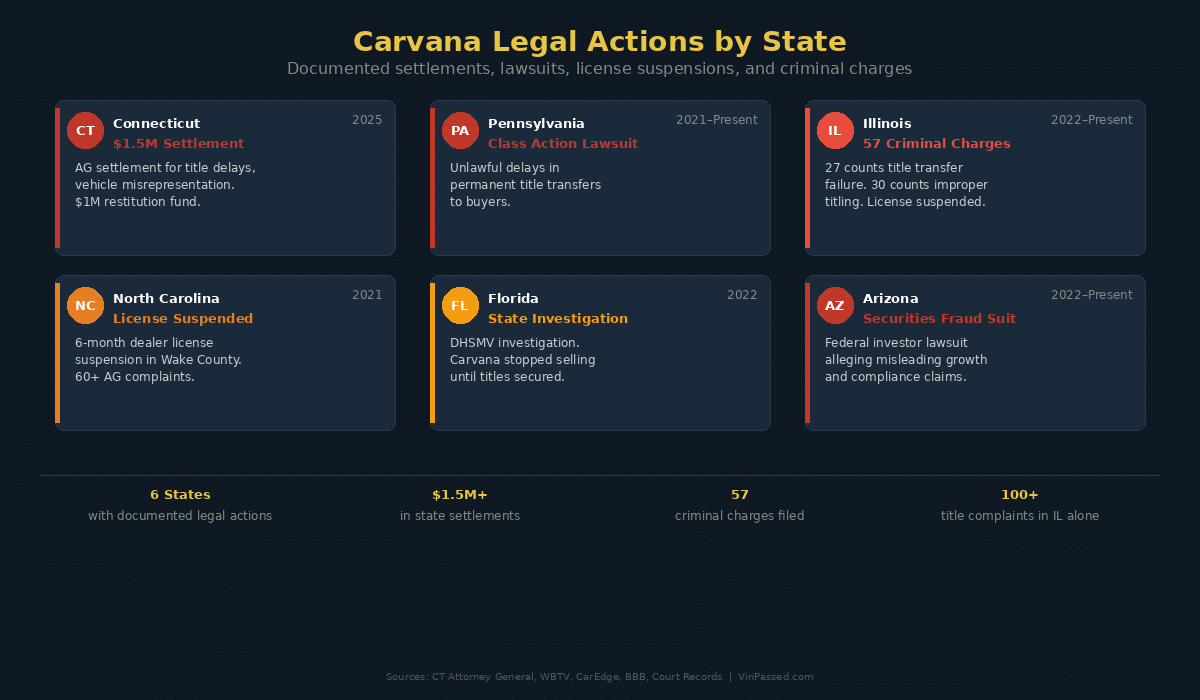
- The Title That Disappeared: A $1.5 Million State Settlement
- What a Free Carfax Actually Covers (And What It Doesn't)
- The 150-Point Inspection: Do the Math
- Why Corners Get Cut: The Financial Reality
- The Difference Between Vehicle History and Vehicle Intelligence
- FAQs: Carvana VIN Check
Eric’s Carvana Vin Check. The Clean Carfax That Wasn’t Clean
Eric Lindsay — North Carolina
Eric did everything right. Before buying a 2008 Infiniti G37 for over $12,000, he checked the Carfax. It was clean. No accidents. No damage. The buyback guarantee badge was right there on the report.
Two months later, Carfax updated Eric's vehicle history to show damage from a 2017 incident — an accident that happened before he bought the car. The information simply wasn't on the report when he purchased it.
Eric filed a complaint with the North Carolina Attorney General's Office. Carfax's response was clear: they only compensate for missing branded title events. Unreported accidents don't qualify. Eric's carvana vin check through Carfax gave him confidence. It just didn't give him the truth.
Source: WBTV Investigative Report, North Carolina Attorney General complaint records
Eric's experience isn't rare. A WBTV investigation uncovered three separate buyers in the same state who purchased vehicles with clean Carfax reports, only to discover unreported accident histories after the sale. The pattern was identical each time: clean report at purchase, updated report weeks later, and Carfax declining to help because the damage didn't involve a branded title.
Carfax themselves acknowledge this gap. Their own support page states plainly that "not every accident or damage event is reported and not all reported are provided to CARFAX." When you run a carvana vin check through the free Carfax included with every listing, you're searching a database of reported events — not a complete picture of what actually happened to the vehicle.
Rebecca and the Buyback Guarantee That Guaranteed Nothing
Rebecca Wallace
Rebecca purchased a 2009 Mercedes-Benz in 2016. Before buying, her insurance company provided a Carfax vehicle history report showing "no accident/damage reported to CARFAX." She felt protected. She had the guarantee.
In 2017, a minor collision deployed the Mercedes' airbags — and that's when the real story surfaced. The valuation report revealed prior unreported damage. Rebecca's "clean" car had a hidden past that Carfax never disclosed.
She went to Carfax asking for compensation under the buyback guarantee. A Carfax employee wrote back: "CARFAX only offers compensation for missing branded title events." The unreported accident damage? Not covered. The $44.99 report with the buyback guarantee badge? It guaranteed nothing that mattered.
Source: WBTV Investigation, North Carolina Attorney General complaint records
The Auto Fraud Legal Center — a law firm specializing in vehicle purchase disputes — puts it bluntly: many dealership employees don't rely on Carfax reports themselves. They hand the "clean" report to customers knowing the information may be incomplete. The report is a sales tool that looks like a consumer protection tool.
Every carvana vin check that returns a clean Carfax creates the same false confidence. The buyer sees green checkmarks and a guarantee badge. What they don't see are the events that were never reported, the damage that was repaired off-book, and the fine print that makes the guarantee almost impossible to collect.
Marcus Paid $38,000 for an Undisclosed Wreck
A Pennsylvania buyer (identity protected in legal filing)
He purchased a vehicle from Carvana with a Carvana Vin Check from Carfax for $38,000. The Carfax was Clean. Passed the 150-point inspection. Everything looked perfect on the listing.
Twelve months later, he discovered the car had been in a serious accident that was never disclosed at the time of sale. By then, the vehicle had depreciated $20,000 from his purchase price. When a check engine light appeared, the mechanic quoted him $7,200 in repairs.
He contacted Carvana. Their response was, in his words, "indifferent and rude." He had indisputable proof of prior accident damage. He was holding a $7,200 repair bill on a car that had lost more than half its value. And the company that sold it to him wouldn't engage.
Source: JustAnswer legal consultation filing, Pennsylvania
This story raises the question every carvana vin check should answer before purchase: what happened to this car before Carvana bought it?
Carvana acquires a significant portion of its inventory through wholesale auto auctions. A vehicle can be totaled in an accident, purchased at salvage auction, cosmetically repaired, and resold — sometimes with a clean title if the repairs meet certain state thresholds or if the vehicle crosses state lines during the process. A standard Carvana Vin Check Carfax report may show the auction sale, but it won't show photos of the vehicle's condition at auction. It won't show what the damage looked like before reconditioning. And it won't tell you whether the structural repairs were done correctly or just done cheaply.
The Day 8 Problem: When the 7-Day Window Slams Shut
A buyer — check engine on Day 8
She bought a car with a Carvana Vin Check from Carfax. It ran fine for the first week. On day 8 — one day past the 7-day return window — the engine light came on and the car wouldn't accelerate.
Carvana refused a return. They directed her to SilverRock, their warranty partner, which would cover repairs but not a rental car upfront. She needed $1,200 out of pocket for a rental deposit while her 8-day-old car sat in a shop. She didn't have it. She couldn't get to work.
Source: JustAnswer legal consultation, Consumer Protection inquiry
Carvana's 7-day money-back guarantee is the safety net that convinces hesitant buyers to commit. But the fine print creates traps that swallow real people.
A ConsumerAffairs review from January 2026 describes another buyer whose check engine light appeared 9 days after delivery — just barely outside the return window. Another buyer tried to return within the 7-day period after problems appeared within 50 miles, but Carvana couldn't confirm whether their trade-in had already been "routed out of state." They were stuck in limbo: returning the bad car but unable to get their own vehicle back.
A BBB complaint documents a vehicle delivered with summer-only tires in cold weather, a sidewall bulge, seven-year-old front tires exceeding industry service limits, and mismatched tread depths causing traction control malfunctions. The vehicle couldn't be safely driven for evaluation during the 7-day period. SilverRock denied the claim. Carvana refused remediation.
There's also the 400-mile ceiling. You get 7 days and 400 additional miles — whichever comes first. Drive to a mechanic, test the highway, run some errands. You can burn through 400 miles in two days and lose your return rights on day 3. And even when Carvana agrees to a return, scheduling pickup takes time. Initiate on day 6, pickup rescheduled to day 9 — you're in a gray zone with no guaranteed protection.
The carvana vin check you run before purchase determines whether you ever need that 7-day window at all. And that's the difference between hoping for protection and having actual intelligence.
The Title That Disappeared: A $1.5 Million State Settlement
Hundreds of Connecticut buyers — and a state investigation
In January 2025, Connecticut Attorney General William Tong announced a $1.5 million settlement with Carvana following hundreds of consumer complaints. The problems: extended delays in title and registration documents, delayed payments to sellers, and what the AG called "deceptive representations of car conditions and features."
Some buyers waited months for registration. Others were given a string of out-of-state temporary tags. Some were forced to park their cars or risk driving unregistered vehicles. One buyer submitted paperwork repeatedly over the course of months, getting different answers from every representative.
The AG's words: "This is a company that grew faster than it could manage. Carvana made promises it simply could not keep, and its customers paid the price."
Source: Connecticut Attorney General Press Release, January 2025
Connecticut wasn't alone. A class action lawsuit in Pennsylvania alleges Carvana unlawfully delayed title transfers. North Carolina suspended Carvana's dealer license in Wake County for six months. Illinois filed 57 criminal charges against Carvana's lead lawyer — 27 counts of failure to transfer titles and 30 counts of improper use of titling and registration. In Illinois alone, investigators documented over 100 complaints about title transfer failures.Carvana Vin Check never disclosed any title issues. Complete vehicle intelligence from a third party would.
Title problems don't just mean paperwork delays. When titles move slowly or disappear across state lines, it creates conditions where title history can become murky. A vehicle that was totaled in one state, repaired, and retitled in another may appear clean in certain databases. A carvana vin check through a standard history report may not catch title discrepancies that a deeper intelligence analysis — one that cross-references auction records, title transfers across states, and insurance loss records — would surface immediately.
What a Carvana Vin Check with Free Carfax Actually Covers (And What It Doesn’t)
When Carvana Vin Check provides a free Carfax with every listing, most buyers assume they're getting a complete vehicle history. The reality is more limited than the marketing suggests.
What Carfax reports:
Title records from state DMVs. Accidents reported by police departments and insurance companies. Service records from participating shops and dealerships. Odometer readings from state inspections. Recall information from manufacturers.
What Carfax does not report:
Accidents that weren't reported to police or insurance. Damage repaired out of pocket or at non-participating shops. The actual condition of the vehicle at auction. Structural integrity assessments. Predicted maintenance and repair costs. Whether the reported events indicate a high-risk or low-risk vehicle. Any form of confidence assessment about whether you should buy this specific car.
Carfax is a database, not an analysis. It tells you what was reported. It doesn't tell you what it means. And for a buyer running a carvana vin check to decide whether to spend $20,000, $30,000, or $40,000 — the interpretation is everything.
A Carfax report showing three owner changes, two service records, and one minor accident looks reasonable on paper. But was that "minor accident" actually structural? Was the vehicle sold at auction between owners — and if so, what did it look like at auction? Are the service gaps between ownership periods hiding deferred maintenance that's about to become your problem? Carfax can't answer any of these questions. It was never designed to.
The 150-Point Inspection: Do the Math
Carvana's 150-point inspection is central to their marketing promise. The number sounds thorough. But when you examine what 150 points actually means — and what it takes to process the volume Carvana handles — the picture changes.
The Volume Reality
Carvana sold 416,348 vehicles in 2024. That's roughly 1,140 cars per day across their inspection and reconditioning network. Each vehicle needs inspection, reconditioning, paint correction, detailing, photography, and listing — before it ships.
A legitimate independent pre-purchase inspection (PPI) costs $200–$300 and takes a qualified mechanic 2–3 hours. That's what thoroughness looks like for one car. The math on doing that for 1,140 cars per day across limited facilities doesn't add up to the same level of scrutiny.
Now consider what those 150 points actually are. The majority are basic operational checks: windshield wipers function, windows go up and down, horn works, hood latch clicks, door handles operate, turn signals blink, brake lights illuminate, seat belts click. A technician can walk around a vehicle and check 40–50 of these points in under five minutes without opening the hood.
The points that actually matter to your safety and investment — frame integrity, undercarriage condition, leak inspection on a lift, transmission behavior under load, brake rotor measurement, suspension component wear, comprehensive OBD diagnostic scanning, electrical system testing — represent maybe 20–25 of those 150 points. And they're the ones that require a lift, diagnostic equipment, road testing, and time.
A real pre-purchase inspection that covers those critical items costs $200–$300 for a single car because it genuinely takes 2 hours of a qualified mechanic's time. That's the standard the industry has established through decades of practice. The question every carvana vin check should prompt is simple: at the volume Carvana processes, is every vehicle getting that level of attention?
The complaint patterns — vehicles arriving with damaged subframes, flood indicators, failing transmissions, inoperable safety systems — suggest the answer isn't always yes.

Why Corners Get Cut: The Financial Reality
Understanding why these problems persist requires looking at the business behind the brand.
Carvana was founded in 2012, spun out of DriveTime — a used car dealership chain. It went public in 2017 and grew explosively, reaching a $60 billion market cap at its peak. Then reality arrived.
By the end of 2022, Carvana had accumulated $9 billion in total debt. The stock had fallen 99% from its peak. The company laid off more than 4,000 employees. Financial analysts openly discussed bankruptcy. In a single year — 2022 — Carvana posted a net loss of $1.59 billion, more than the company's combined losses from 2014 through 2021.
The company negotiated a debt restructuring in 2023 that cut about $1.3 billion in obligations, and finally posted its first annual profit in early 2024. That turnaround was real and credit is due. But it came through aggressive cost cutting — and the company still carries approximately $5.6 billion in total debt as of late 2025.
Meanwhile, Hindenburg Research — the firm known for exposing fraud at Nikola Motors — published a detailed report in January 2025 raising questions about Carvana's accounting practices and insider stock sales, calling the turnaround into question.
None of this means Carvana is a bad company or that every car they sell is a problem. Millions of buyers have had perfectly fine experiences. But it raises a legitimate question: when a company processing 450,000 cars a year is under intense pressure to maintain profitability while servicing billions in debt — where do the cost efficiencies happen? Not in marketing. Not in the vending machines. The efficiencies happen in the parts the customer can't see until it's too late.
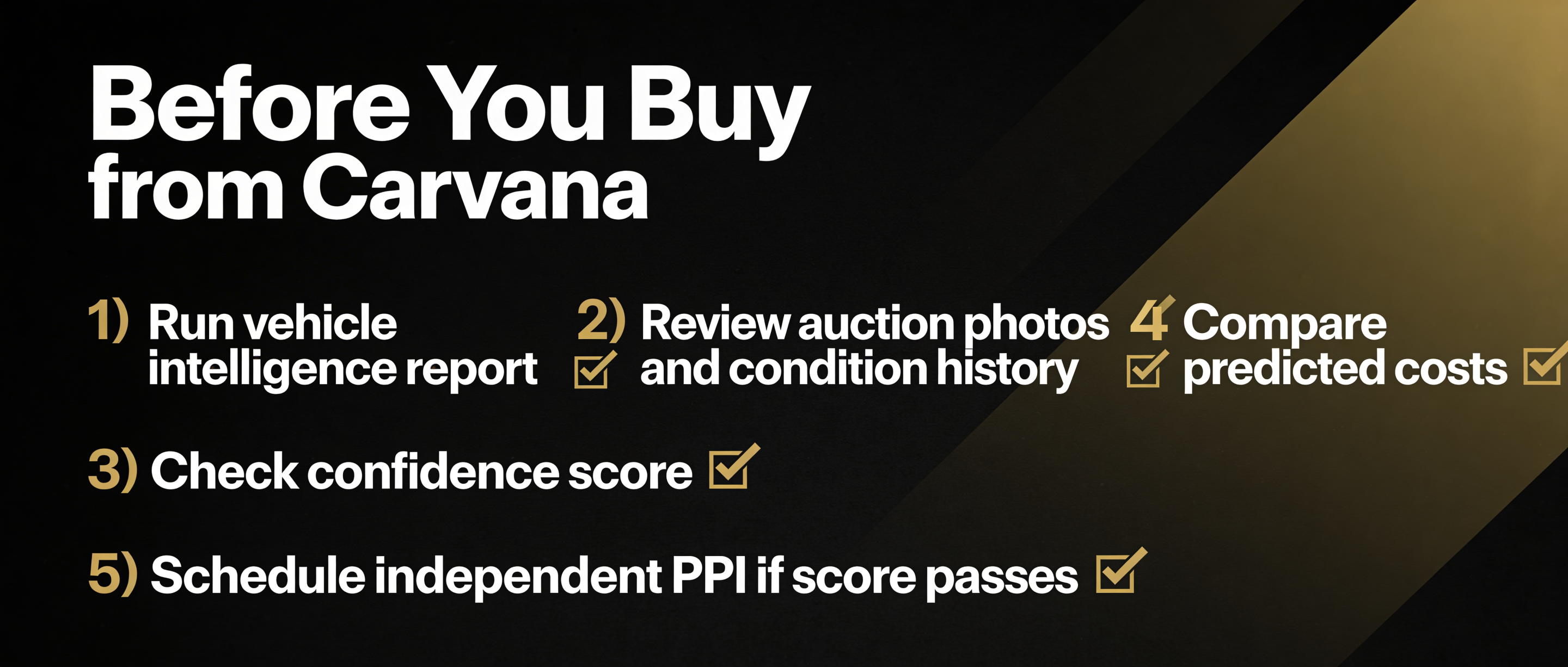
Your carvana vin check shouldn't depend on hoping your car got a thorough inspection. It should confirm it independently.
The Difference Between Vehicle History and Vehicle Intelligence
Every story in this article follows the same arc. A buyer trusted the system — the free Carfax, the 150-point inspection, the 7-day return window, the buyback guarantee. And the system wasn't designed to protect them the way they assumed.
The gap isn't information. There's plenty of data available about any vehicle with a VIN. The gap is intelligence — the ability to take that data and tell you what it actually means for your decision.
What If These Buyers Had Vehicle Intelligence?
Eric would have seen the accident history that Carfax hadn't yet added to their database — because vehicle intelligence pulls from auction records, insurance loss databases, and repair facility data that doesn't always flow through traditional history report channels.
Rebecca wouldn't have relied on a buyback guarantee she'd never be able to collect. She'd have seen a confidence score that reflected the vehicle's actual risk profile — not just a badge that looked like protection.
The PA buyer would have seen auction photos showing the vehicle's condition before Carvana's reconditioning. The damage that cost him $7,200 to repair would have been visible in pre-sale photos — if he'd had access to them.
The Day 8 buyer would have known about risk factors before delivery, not after. A low confidence score would have triggered a harder look — or a different car entirely.
Connecticut's title victims would have seen title transfer patterns and state-crossing history that flagged potential registration complications before money changed hands.
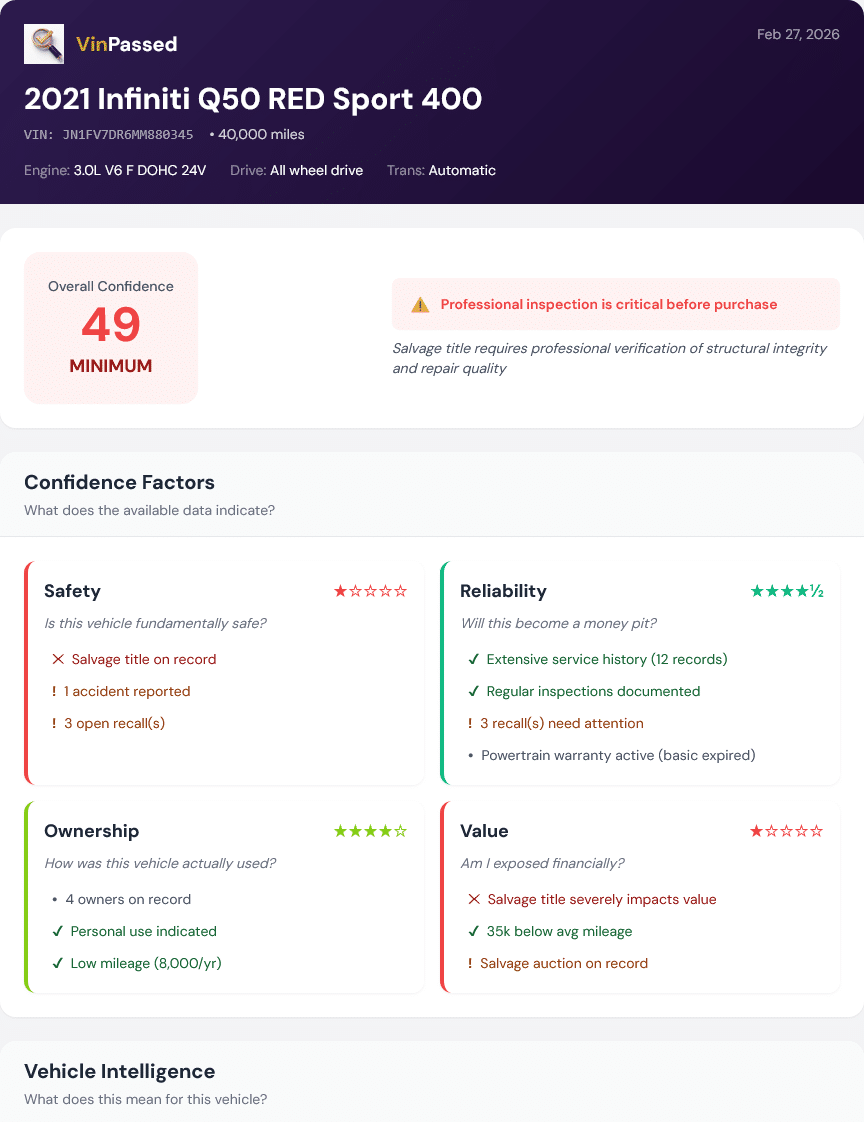
This is what a VinPassed vehicle intelligence report delivers. Not just history. Intelligence. Every carvana vin check through VinPassed analyzes the vehicle's complete data footprint and returns a Confidence Score — a single number that tells you whether this car deserves your trust.
The Confidence Score evaluates four dimensions: Safety, Reliability, Ownership history, and Value. Red flags are surfaced and ranked by severity — not buried on page 10 of a timeline. Auction photos show you what the vehicle looked like before it was cleaned up and listed. Predicted maintenance costs tell you what this car will cost you over the next 12–24 months. And AI-powered analysis explains what every data point means in plain language.
History reports dump data. VinPassed digs deep into that data and shows you what it means and how to use it.
Check Any Carvana VIN Before You Buy
Don't trust a free report to protect a $25,000 decision. Get complete vehicle intelligence with auction photos, AI-ranked findings, predicted costs, and a Confidence Score that tells you what the data means — not just what was reported.
Get Vehicle Intelligence Starting at $15 →Single reports $29.99 · Multi-report bundles save up to 50% · Reports never expire · No subscription
Related reading: Carvana 150 Point Inspection: Find Out What's Missing — our deep investigation into exactly what the 150-point inspection covers, the five critical blind spots it misses, and a 7-day survival checklist every Carvana buyer should follow.
FAQs: Carvana VIN Check
Does Carvana provide a free VIN check?
Carvana provides a free Carfax report with every listing. However, a Carfax report is a vehicle history report — it only includes events that were reported to Carfax's database. It does not include unreported accidents, auction condition photos, confidence scoring, predicted repair costs, or AI-powered risk analysis. For a complete carvana vin check, you need vehicle intelligence that goes beyond reported history.
Is the Carfax buyback guarantee reliable?
The Carfax buyback guarantee only covers DMV-issued title brands (salvage, junk, rebuilt, flood, lemon) that were issued at least 60 days before the report and were not included. It does not cover unreported accidents, hidden damage, mechanical defects, or misrepresented vehicle conditions. Claims must be filed within one year, and accepting payment waives all future claims. Multiple consumer investigations have documented widespread difficulty collecting on buyback claims.
What does Carvana's 150-point inspection actually check?
Carvana's 150-point inspection covers operational items including lights, windows, locks, seat belts, horn, wipers, and fluid levels, along with some mechanical and structural checks. However, the majority of those 150 points are basic visual and functional checks. At the volume Carvana processes — over 400,000 vehicles annually — consumer complaint patterns suggest not every vehicle receives the same level of scrutiny. An independent pre-purchase inspection remains the safest approach.
Can I return a car to Carvana if I find problems?
Carvana offers a 7-day money-back guarantee with a 400-mile limit. However, documented complaints show problems often surface on day 8 or later, trade-in vehicles may not be retrievable during the return process, shipping fees may not be refundable, and some vehicles arrive in conditions that make meaningful evaluation unsafe within the window. Running a thorough carvana vin check before purchase reduces the risk of needing the return policy at all.
How is VinPassed different from Carfax for a carvana vin check?
Carfax is a vehicle history database — it shows events that were reported. VinPassed is vehicle intelligence. It analyzes the complete data footprint including auction photos showing pre-repair condition, AI-powered confidence scoring across safety, reliability, ownership, and value dimensions, predicted maintenance costs, and risk-ranked findings that surface red flags automatically. Reports start at $15 with multi-report bundles, never expire, and require no subscription.
Should I get an independent inspection on a Carvana car?
Yes. Consumer Reports and AAA both recommend independent pre-purchase inspections on any used vehicle regardless of the seller. A carvana vin check through VinPassed can help you decide whether a specific vehicle is worth the $200–$300 PPI investment — or whether red flags suggest walking away before spending a dime.
Has Carvana faced legal action for vehicle issues?
Yes. Carvana has faced a $1.5 million settlement in Connecticut for consumer complaints including title delays and vehicle misrepresentation, a class action lawsuit in Pennsylvania for delayed title transfers, dealer license suspensions in North Carolina, and criminal charges in Illinois related to title and registration violations. A securities fraud lawsuit is also proceeding in federal court in Arizona.