Carvana 150 Point Inspection: What It Actually Covers and What It Misses An independent look at what Carvana checks, what slips through, and how to verify any Carvana car before you buy.
Carvana sold 416,348 vehicles in 2024 — a 33% jump from the prior year. Every single one supposedly passed the carvana 150 point inspection before reaching a buyer's driveway. Yet Carvana holds a 1.2-star rating from over 2,000 BBB reviews, and a recurring theme in complaints is clear: vehicles with serious problems that the inspection should have caught.
This isn't a hit piece. Carvana's convenience is real, and plenty of buyers have smooth experiences. But the carvana 150 point inspection is the foundation of their quality promise, and buyers deserve to know exactly what it does and doesn't cover — a principle echoed by Federal Trade Commission used car buying guidance — because by the time you discover a problem, the 7-day return window may already be closing.
In This Article
- What the Carvana 150 Point Inspection Actually Checks
- The Documented Gaps: What the Inspection Misses
- Real Complaints That Passed the Carvana 150 Point Inspection
- The Auction Photo Advantage: Seeing Before Reconditioning
- How to Verify Any Carvana Car Before You Buy
- Your 7-Day Window: A Survival Checklist
- The Bottom Line
- Frequently Asked Questions
What the Carvana 150 Point Inspection Actually Checks
Carvana describes the carvana 150 point inspection as a comprehensive review covering mechanical, cosmetic, and safety standards. According to their published help documentation, any component that fails to meet standards is "either replaced or repaired." Every vehicle also receives an oil change.
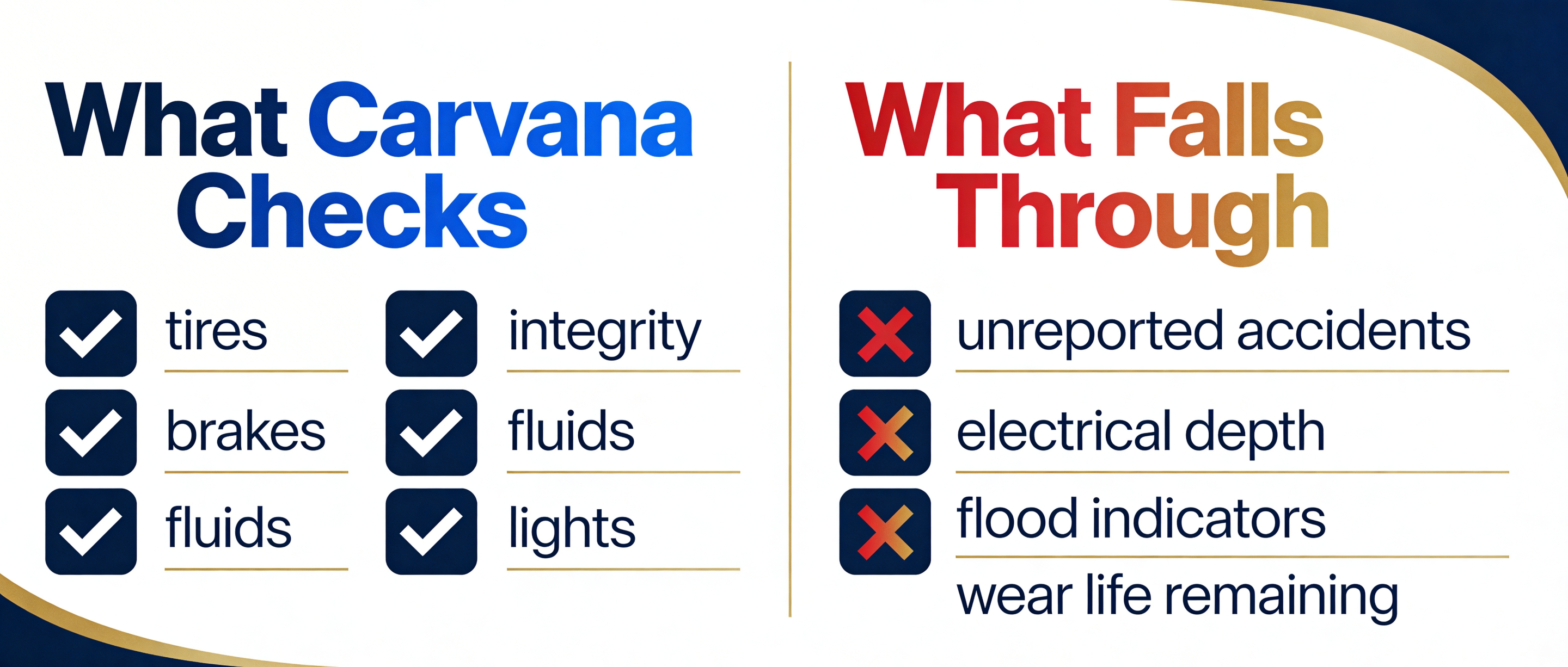
Here's the problem: Carvana has never published the full 150-point checklist. We know the broad categories from their marketing and SEC filings, but the specific pass/fail criteria remain internal. Based on their published statements and their Carvana Certified program page, the carvana 150 point inspection covers these general areas:
What We Know Is Checked
| Category | What Carvana States | Key Limitation |
|---|---|---|
| Tires & Brakes | DOT tread depth standard; below-standard tires replaced | DOT minimum is 2/32" — most mechanics recommend replacement at 4/32" |
| Engine & Drivetrain | Operational check, oil change included | No mention of compression testing or internal wear assessment |
| Safety Systems | Lights, signals, and basic safety components | Unclear if advanced safety systems (ADAS, sensors) are calibrated |
| Cosmetic Standards | Uniform cosmetic standard; imperfections disclosed in photos | Reconditioning includes paintless dent repair and paint — can mask prior damage |
| Fluids | All fluids checked | Fresh fluids can temporarily mask leaks and contamination |
| History Screening | No reported accidents, fire, frame, or flood damage per Carfax/AutoCheck | Only catches damage that was reported — unreported damage invisible |
The Documented Gaps: What the Carvana 150 Point Inspection Misses
No used car inspection is perfect. But the gap between Carvana's marketing language ("supreme confidence") and documented buyer experiences reveals specific, recurring blind spots in the carvana 150 point inspection process.
Blind Spot #1: Pre-Existing Mechanical Wear
The carvana 150 point inspection checks that components function at the time of inspection, but doesn't assess remaining service life. A transmission that shifts smoothly today but has 80% of its life used up still passes. Brake pads at DOT minimum pass even though they'll need replacement within weeks. This distinction between "currently functional" and "reliably functional" is where many buyer complaints originate.
Blind Spot #2: Prior Accident Damage After Reconditioning
Carvana's SEC filings confirm their reconditioning process includes paintless dent repair and paint capabilities at every inspection center. This means body damage is cosmetically corrected before you ever see the car. Combined with the reliance on reported-only accident history, a vehicle with unreported collision damage can be reconditioned to look clean, pass the carvana 150 point inspection, and arrive at your door with no visible evidence of its past.
Blind Spot #3: Electrical System Depth
Modern vehicles contain hundreds of electronic modules controlling everything from engine management to safety systems. A surface-level operational check (do the lights turn on?) doesn't reveal intermittent faults, degraded wiring, or modules throwing codes that were recently cleared. Multiple consumer complaints describe check engine lights appearing within days of delivery.
Blind Spot #4: Water and Flood Damage Indicators
Flood damage that was never filed through insurance won't appear on Carfax or AutoCheck. The National Highway Traffic Safety Administration warns that flood-damaged vehicles pose serious safety risks and are frequently resold without disclosure. Physical indicators like corrosion in electrical connectors, waterline staining under carpets, and silt deposits in hidden compartments require targeted inspection that goes beyond what the carvana 150 point inspection operational check covers. Buyer reports of mold discovery after purchase suggest these indicators aren't consistently caught.
Blind Spot #5: The "Wearable Parts" Exclusion
Carvana's warranty through SilverRock explicitly excludes tires, brake pads, struts, shock absorbers, and other wearable parts. This same exclusion likely applies to inspection standards — components can be worn but still above minimum thresholds, passing the carvana 150 point inspection while being months away from expensive replacement that falls entirely on the buyer.
Real Complaints That Passed the Carvana 150 Point Inspection
These aren't isolated incidents. They represent recurring patterns documented across BBB, Trustpilot, ConsumerAffairs, and Reddit from buyers whose vehicles passed the carvana 150 point inspection:
| Complaint Category | Example | Source |
|---|---|---|
| Structural damage on delivery | Subframe damage discovered on delivery day | ConsumerAffairs, Jan 2026 |
| Brake safety failures | Brake pads installed incorrectly, wearing unevenly | ConsumerAffairs, Jan 2026 |
| Engine failure | Engine fire on expressway, 9 days after delivery | ConsumerAffairs, Jan 2026 |
| Tire safety | Front tires "basically falling apart," unsafe to drive | Trustpilot, 2025 |
| Transmission failure | Reverse gear synchro failed, grinding and clunking from day one | BBB, Jan 2026 |
| Undisclosed body damage | Rear-end damage covered with gloss spray paint | ConsumerAffairs, Jan 2026 |
| Cosmetic cover-ups | Cheap paint on grill washed off in first rain | BBB, 2025 |
To be fair, Carvana sells hundreds of thousands of vehicles annually. The majority of transactions are likely smooth. But when their entire quality promise rests on the carvana 150 point inspection, the documented failure rate matters — especially when you're the buyer receiving a car sight-unseen.
The Auction Photo Advantage: Seeing the Car Before Carvana Touched It
Here's something most Carvana buyers don't realize: many of the cars on Carvana's lot passed through auto auctions before reaching the reconditioning center. Carvana's own SEC filings confirm they acquire inventory from "used car auctions, including by use of our growing digital auction platform" (their ADESA network).
At auction, every vehicle is photographed from multiple angles. These photos document the vehicle's condition at the time of sale — before any reconditioning, paint work, or cosmetic cleanup. This is the raw, unfiltered truth about the car's physical state.
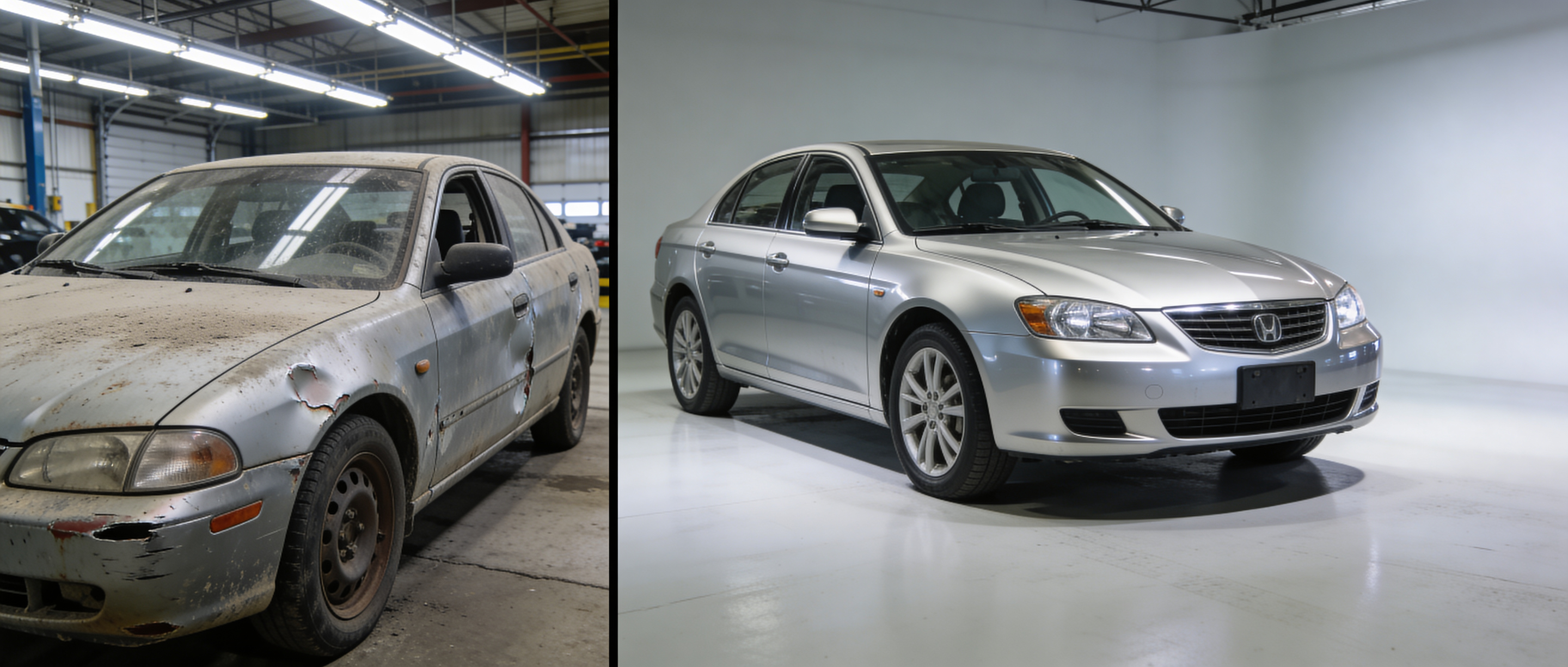
What Auction Photos Reveal
- Body damage before repair: Dents, scrapes, collision damage that was cosmetically corrected during reconditioning
- Interior condition: Stains, wear, tears, and damage before cleanup and detailing
- Missing or damaged parts: Components that were replaced or repaired before listing
- Flood indicators: Waterline marks, debris, mud staining visible in auction-day photos
- Overall wear level: The honest condition of the car at the moment Carvana (or their auction pipeline) acquired it
Neither Carfax nor AutoCheck include auction photos. The Carfax report Carvana provides with every listing won't show you these images. They exist in a separate data layer that most consumers don't know is accessible.
More importantly, traditional reports dump raw history data and leave you to interpret it. Vehicle intelligence services like VinPassed rank every finding by importance with a confidence score, flag specific items to watch for, project upcoming maintenance costs, compare ownership costs against the vehicle's class, and include auction photos — for $15 less than a Carfax report. The raw history is still there, but it's at the bottom where it belongs. The intelligence is up front.
Why This Matters for Carvana Buyers Specifically
Carvana's reconditioning process is designed to make every car look showroom-ready. That's good customer experience. But it also means the car you see in the 360-degree photos on their website is the after picture. Auction photos give you the before — the state of the vehicle when the carvana 150 point inspection process began. If the "before" shows significant damage that was cosmetically repaired, you want to know that before committing $25,000+.
See What Carvana's Inspection Doesn't Show You
AI-ranked vehicle intelligence with a confidence score you can actually understand. Predicted maintenance costs, ownership cost analysis, class comparisons, recall data, auction photos showing pre-reconditioning condition — not just a history dump. Everything ranked by what matters most.
Check Any Carvana VIN — $29.99How to Verify Any Carvana Car Before You Buy
The carvana 150 point inspection is a starting point, not a guarantee. Here's a practical system to independently verify any vehicle on Carvana's lot before you click "buy" or during your 7-day return window.
Step 1: Run an Independent Vehicle History Check
Carvana provides a free Carfax with every listing. That's useful, but it's one data source that only shows raw history. Cross-reference with an independent report that goes deeper — ideally one that ranks findings by importance, assigns a confidence score, and projects future ownership costs. You're specifically looking for:
- Auction history and photos: Did this car go through auction? What did it look like before reconditioning?
- AI-ranked risk assessment: Not just what happened, but what it means and what to watch for
- Predicted maintenance and repair costs: What will this vehicle cost you in the next 12-24 months?
- Ownership cost vs. class: Is this vehicle more expensive to own than comparable models?
- Title discrepancies: Does title history match what Carvana's listing claims? Cross-reference with the National Motor Vehicle Title Information System (NMVTIS)
- Complete recall status: Active recalls that need immediate attention via NHTSA.gov/recalls
Step 2: Scrutinize the Carvana Listing
Before spending money on reports or inspections, mine every detail from the free listing:
- 360-degree photos: Zoom into every panel, every angle. Look for color mismatches, texture inconsistencies, and panel gap variations that indicate body work
- Disclosed imperfections: Carvana marks imperfections with photo annotations. But compare what they disclose against what you see — some buyers report damage that wasn't annotated
- The Carfax they provide: Read the full report, not just the summary. Check the "as of" date — how recent is the data?
- Vehicle specs: Verify the VIN decodes to the exact trim, engine, and options listed
Step 3: Schedule an Independent Inspection Within the 7-Day Window
This is non-negotiable for any vehicle over $10,000. Consumer Reports and AAA both recommend independent pre-purchase inspections for any used vehicle. The moment your Carvana car arrives:
- Pre-schedule a mechanic before delivery day — find an ASE-certified technician so you're not scrambling
- Direct them to focus areas from your report findings and listing review
- Request frame measurement if there's any auction or report indication of collision
- Ask for an OBD scan to check for recently cleared codes
Your 7-Day Window: A Survival Checklist
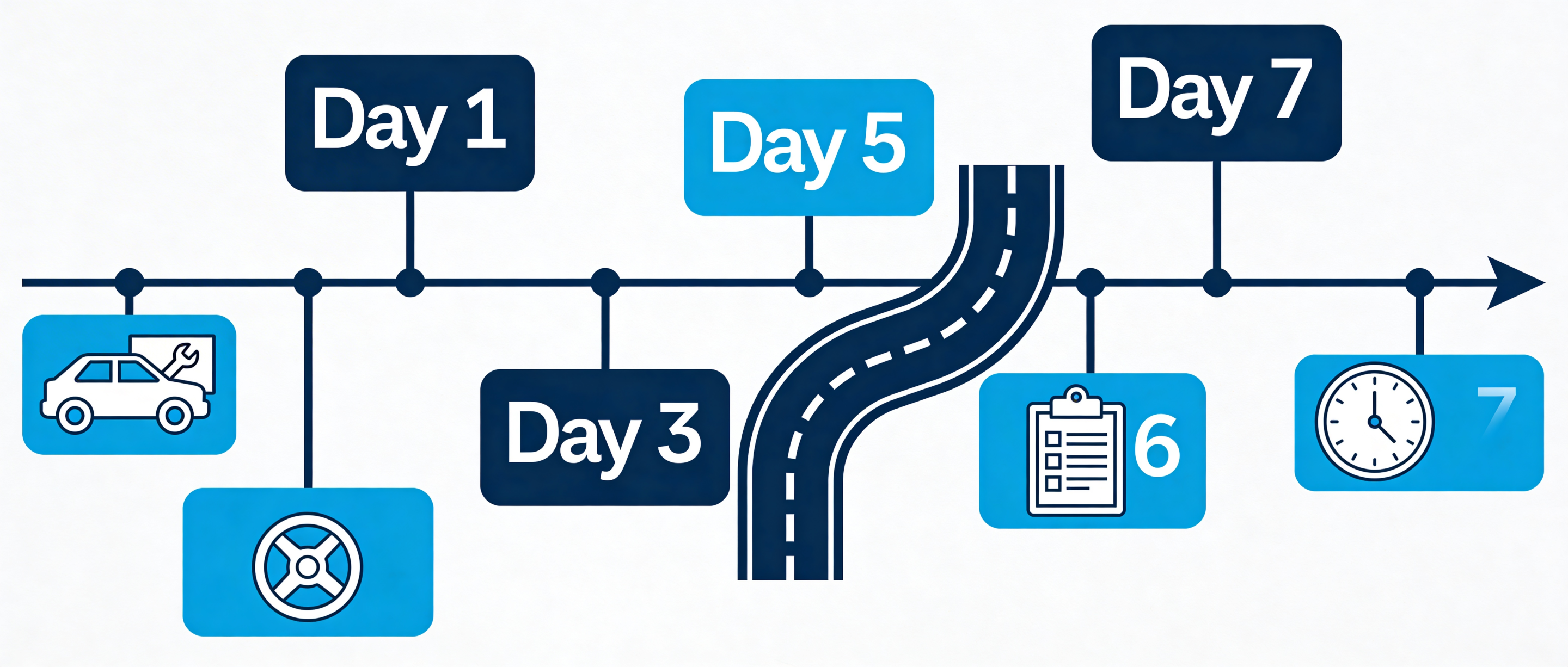
The 7-day return policy is Carvana's strongest buyer protection. Use every hour of it strategically. Here's your day-by-day plan to verify what the carvana 150 point inspection may have missed:
Day 1: Delivery Inspection
- Inspect the entire exterior in daylight before signing anything
- Document every scratch, dent, or imperfection with photos and video
- Check panel gaps, paint texture consistency, and look for overspray on door jambs
- Start the car cold — listen for unusual sounds during cold start and idle
- Verify the VIN on dashboard and door frame matches your paperwork
Day 2: Independent Mechanic Inspection
- Full pre-purchase inspection at an independent shop ($150-300)
- OBD-II scan for active and stored codes
- Frame and alignment check
- Brake and suspension assessment beyond minimum thresholds
- Fluid condition analysis (not just levels)
Days 3-5: Extended Road Test
- Highway driving at sustained speed to test for vibrations and pulls
- Stop-and-go city driving to stress the transmission
- Climate system test in both heating and cooling
- All electronics, sensors, and driver assistance features
- Monitor the temperature gauge across driving conditions
Day 6: Decision Point
- Review mechanic findings, your road test notes, and report data
- If returning: initiate the process today — don't wait until day 7
- Document your mileage — you must be under 400 additional miles
The Bottom Line on the Carvana 150 Point Inspection
The carvana 150 point inspection is a real process performed by trained technicians at Carvana's reconditioning centers. It catches many issues and, for the majority of buyers, results in a vehicle that meets basic operational standards. Carvana isn't a scam — they're a legitimate, high-volume retailer that has genuinely simplified used car buying.
But the carvana 150 point inspection is not an independent evaluation. It's performed by the seller, using undisclosed criteria, on vehicles the seller has financial incentive to pass. The documented gaps — unreported accident damage, marginal wear components, cosmetic reconditioning that masks history — are real and recurring.
The smart play isn't avoiding Carvana. It's verifying independently. Run a second history report. Check for auction photos. Schedule a mechanic within 48 hours of delivery. Use the 7-day window aggressively. A $30 report and a $200 inspection — which RepairPal estimates is a fraction of what even minor undisclosed problems cost — are cheap insurance on a $25,000+ purchase — especially when you can see exactly what the car looked like before the carvana 150 point inspection process began.
Check Any Carvana VIN Before You Buy
A confidence score that ranks the vehicle's risk level. AI-flagged items to watch for. Predicted maintenance and repair costs. Ownership cost vs. class average. Auction photos showing pre-reconditioning condition. Full recall history. Market value analysis. And yes, complete service and title history too — it's just not the most important part.
Run a VinPassed Report — $29.99