Vehicle History Reports 2026: The AI Revolution

The Bottom Line: Vehicle history reports 2026 are no longer static documents that dump raw data and leave you to figure it out. The AI revolution has fundamentally changed what these reports can do—transforming them from simple record lookups into intelligent analysis tools that interpret data, calculate confidence scores, and tell you exactly what matters for the vehicle you're considering.
If you're shopping for a used car in 2026, you already know you need a vehicle history report. But here's what most buyers don't realize: not all vehicle history reports are created equal, and the gap between what traditional reports provide versus what's now possible has never been wider.
This guide explains exactly what your vehicle history reports 2026 should tell you, how AI-powered analysis works, and why the old way of doing things leaves critical gaps that could cost you thousands.
The Problem With Traditional Vehicle History Reports 2026

Traditional vehicle history reports 2026 were designed with a fundamental flaw: they exist primarily to help dealers sell cars, not to help buyers avoid bad ones.
Think about it. When a dealer purchases a vehicle at auction, they have access to detailed inspection reports, damage assessments, repair cost estimates, and photos showing exactly what condition that vehicle was in. They know what they paid. They know what was wrong with it. They know what it took to make it "retail ready."
When you walk onto that lot, you get a shiny car with a fresh detail and a basic vehicle history report that shows a timeline of events with no interpretation, no analysis, and no context for what any of it actually means.
The Information Asymmetry Problem
Dealers operate with complete vehicle intelligence. Buyers operate with fragments. This imbalance has existed since vehicle history reports were invented—and traditional providers have done little to close the gap.
What Traditional Reports Get Wrong
Most vehicle history reports 2026 still operate on an outdated model. They collect data from various sources, dump it into a chronological list, and leave you to interpret what "DEALER INVENTORY" or "SERVICE RECORD" actually means for the vehicle's condition.
- Raw data without interpretation—you're expected to be the expert
- No confidence scoring—every vehicle looks roughly the same
- Missing auction intelligence—the data dealers use stays hidden
- No AI analysis—just facts without context
- No financial impact assessment—what does this history mean for value?
- No actionable guidance—what should you actually do with this information?
The result? Buyers pay for vehicle history reports 2026, feel somewhat reassured, and still end up surprised when problems emerge. The report technically contained the warning signs—but no one explained what they meant.
The Data Overload Problem
Here's the other issue with traditional vehicle history reports 2026: even when they contain good data, there's too much of it presented without hierarchy or prioritization.
A 10-year-old vehicle might have 50+ events in its history. Which ones matter? Which ones are routine? Which ones should make you walk away? Traditional reports don't tell you. They just list everything and hope you figure it out.
This is where the AI revolution changes everything.
How AI Is Transforming Vehicle History Reports 2026
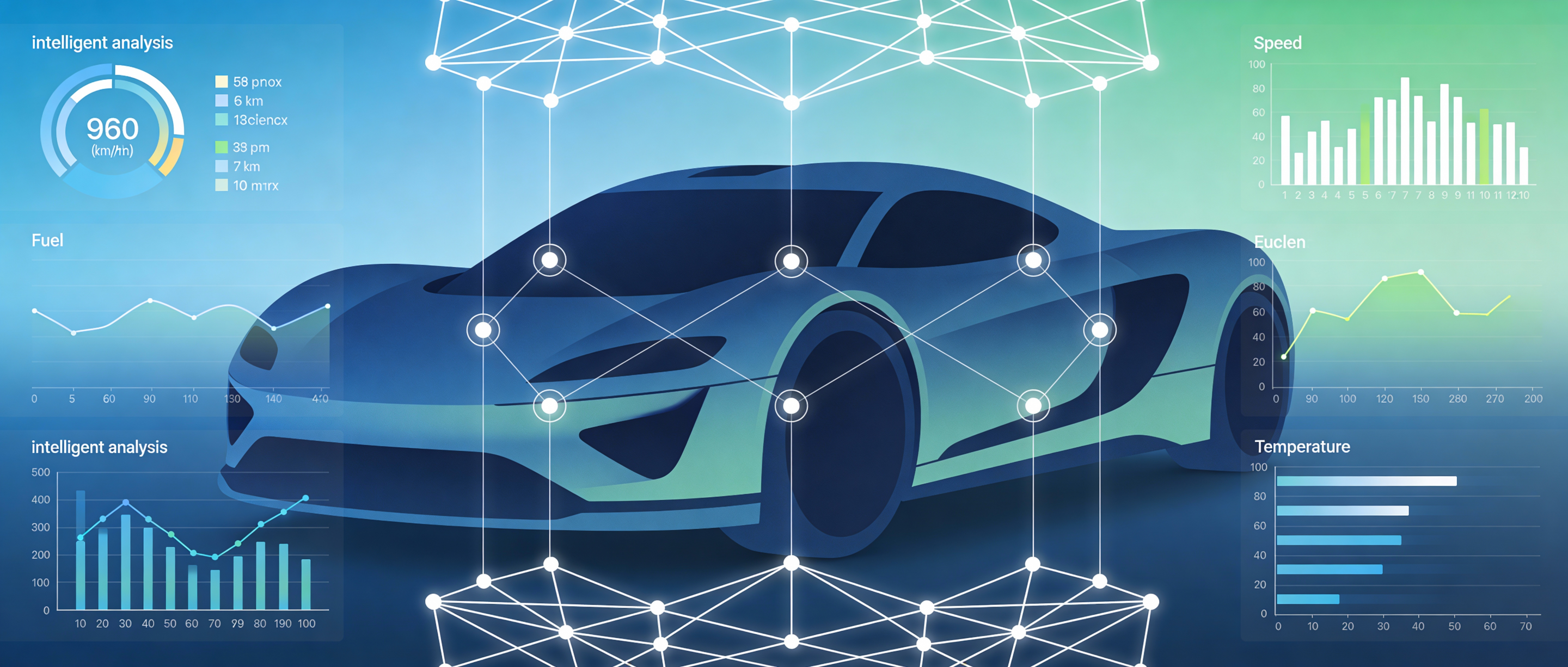
The AI revolution in vehicle history reports 2026 isn't about flashy technology for its own sake. It's about solving a real problem: helping normal people understand complex vehicle data without needing to be automotive experts.
Here's what AI-powered vehicle history reports 2026 can now do that traditional reports cannot:
AI-Powered Analysis Capabilities
- Interpret raw data and explain what it means in plain language
- Calculate confidence scores across multiple categories
- Research make/model-specific issues relevant to the vehicle's mileage
- Identify patterns that indicate problems (ownership turnover, service gaps)
- Calculate value impact from title brands, accidents, and history
- Generate specific questions to ask sellers
- Provide repair cost estimates based on known issues
- Recommend inspection priorities based on findings
From Data Dump to Intelligent Analysis
The difference between traditional vehicle history reports and AI-powered vehicle history reports 2026 is the difference between getting a stack of medical test results versus having a doctor explain what they mean.
AI analysis reads the entire vehicle history, cross-references it with known issues for that specific make, model, and year, considers the current mileage, and produces an actual assessment—not just a list of facts.
Example: What AI Analysis Reveals
A traditional report might show: "Service Record - 06/15/2024 - 95,000 miles"
An AI-powered report tells you: "This 2018 model is now in the mileage range where transmission issues commonly appear. The vehicle shows regular service history, but there's a 2-year gap between 2021-2023 that warrants investigation. Based on auction data, similar vehicles with this history typically sell for 15-20% below clean retail."
This is the AI revolution applied to vehicle history reports 2026. Not artificial intelligence for marketing purposes—but genuine analysis that helps you make better decisions.
Understanding Confidence Scores: The New Standard

One of the most significant advances in vehicle history reports 2026 is the confidence scoring system. Instead of leaving you to interpret raw data, modern reports calculate scores across key categories that answer the questions buyers actually care about.
A comprehensive confidence system evaluates vehicles across four critical dimensions:
🛡️ Safety
The Question: Is this vehicle fundamentally safe?
This category examines title status, accident history, structural damage, airbag deployments, and open recalls. A vehicle with a salvage title or structural damage will score low here regardless of how good it looks on the surface.
🔧 Reliability
The Question: Will this become a money pit?
This category analyzes service records, maintenance patterns, recall history, and warranty status. A vehicle with consistent maintenance history and active warranty coverage scores higher than one with gaps and expired coverage.
👤 Ownership
The Question: How was this vehicle actually used?
This category evaluates ownership count, usage type (personal, rental, fleet, commercial), and mileage patterns. A single-owner personal vehicle with average mileage scores higher than a five-owner former rental with high miles.
💰 Value
The Question: Am I exposed financially?
This category assesses financial risk factors including title brands, mileage versus average, auction history, and accident impact on resale value. It helps you understand what you should actually pay.
Why Confidence Scores Matter
Without confidence scores, every vehicle history report looks roughly the same. You get a list of events and have no way to quickly assess whether this is a good vehicle or a risky one.
With confidence scores, you immediately know where to focus your attention. A vehicle scoring high across all four categories is fundamentally different from one with a low safety score—even if both have "clean" titles on traditional reports.
The Overall Confidence Score
Advanced vehicle history reports 2026 combine these four categories into an overall confidence score (typically 0-100) that gives you an instant read on the vehicle:
| Score Range | Confidence Level | What It Means |
|---|---|---|
| 85-100 | HIGH | Available data shows no significant concerns. Standard inspection suggested. |
| 70-84 | MODERATE | Some factors warrant attention. Pre-purchase inspection recommended. |
| 50-69 | LOW | Multiple concerns identified. Professional inspection strongly advised. |
| 0-49 | MINIMUM | Significant issues detected. Inspection critical before any purchase decision. |
This is what the AI revolution means for vehicle history reports 2026: instant, quantified assessment instead of guesswork.
Safety Analysis: What Your Vehicle History Reports 2026 Should Reveal
Safety is the most critical category in any vehicle history report. In 2026, a comprehensive safety analysis should examine multiple factors that directly impact whether a vehicle is fundamentally safe to drive.
Title Status
Your vehicle history reports 2026 should clearly identify any title brands that indicate past problems:
- Clean Title: No damage-related brands on record
- Salvage Title: Vehicle was declared a total loss by an insurance company
- Rebuilt Title: Previously salvage, now repaired and re-inspected
- Flood Damage: Vehicle was in a flood—electrical problems likely
- Fire Damage: Vehicle was in a fire—structural integrity compromised
- Lemon Title: Manufacturer bought back due to persistent defects
Title Washing Warning
Some vehicles are moved between states to "wash" their titles—a salvage title in Florida might become a clean title in another state. Comprehensive vehicle history reports 2026 should track titles across all 50 states to catch this.
Structural Damage
Structural damage to the frame or unibody is one of the most serious issues a vehicle can have. It affects crash protection, handling, and long-term reliability. Your report should specifically flag any structural damage in the vehicle's history.
Accident History
Not all accidents are equal. Your vehicle history report should distinguish between:
- Minor accidents with cosmetic damage only
- Moderate accidents requiring body work
- Major accidents involving structural damage
- Accidents with airbag deployment (indicates significant impact)
Open Recalls
Safety recalls are free to repair at any dealer, but only if you know about them. Your vehicle history report should list all recalls for the vehicle and indicate which have been completed versus which remain open.
Reliability Analysis: Predicting Future Problems
The reliability category in vehicle history reports for 2026 goes beyond just listing service records. It analyzes patterns that predict whether this vehicle will be dependable or become a money pit.
Service Record Analysis
A vehicle with 20+ documented service records tells a different story than one with zero records. But quantity isn't everything—the AI revolution enables analysis of service patterns:
- Regular oil changes at appropriate intervals
- Scheduled maintenance completed on time
- Consistent service location (single trusted mechanic)
- Proactive repairs before failures
- Large gaps between service visits (2+ years)
- Only emergency repairs (nothing preventive)
- Constantly changing service locations
- No records despite high mileage
Warranty Status
One factor traditional vehicle history reports ignore is warranty status. In 2026, comprehensive reports should calculate warranty coverage based on the vehicle's in-service date and current mileage:
- Bumper-to-Bumper Active: Full factory warranty still in effect—significant value
- Powertrain Only: Basic warranty expired but major components covered
- All Expired: No factory coverage remains—buyer assumes all repair risk
Warranty status directly impacts reliability scoring because an active warranty provides protection against unexpected repair costs.
Make/Model-Specific Issues
This is where AI-powered vehicle history reports in 2026 truly shine. The analysis should research known issues for the specific year, make, and model—and flag when the vehicle is in the mileage range where those problems typically occur.
AI Research Example
A 2017 Honda CR-V at 95,000 miles? AI analysis notes that oil dilution issues were common in 2017-2018 models and recommends asking about oil change frequency and any fuel smell in the oil.
A 2015 Nissan Altima at 110,000 miles? AI analysis flags that CVT transmission failures commonly occur between 90,000-130,000 miles and suggests budgeting for potential transmission work.
Ownership Analysis: Understanding How the Vehicle Was Used
The ownership category reveals patterns about how a vehicle was actually driven—information that significantly impacts its condition and future reliability.
Owner Count
Single-owner vehicles typically command premium prices for good reason. Each ownership transfer introduces uncertainty about maintenance habits and driving style.
Your vehicle history report should analyze ownership patterns, not just count owners:
- 1 Owner: Consistent care, known history
- 2-3 Owners: Normal for older vehicles
- 4+ Owners: May indicate problems causing quick resales
- 5+ Owners: Red flag—why does no one keep this vehicle?
Usage Type
How a vehicle was used matters enormously. Vehicle history reports in 2026 should identify usage patterns:
- Personal Use: Typically best case—driven by someone who cared
- Rental Fleet: High driver turnover, often driven hard
- Corporate Fleet: Regular maintenance but high miles
- Commercial/Taxi: Extreme wear, constant use
- Police/Government: High-stress driving, potential pursuit use
Mileage Patterns
Average mileage is approximately 12,000-15,000 miles per year. Your vehicle history report should calculate actual annual mileage and flag anomalies:
- Below Average (<10,000/year): Light use, but watch for short-trip wear
- Average (10,000-15,000/year): Normal driving patterns
- Above Average (15,000-20,000/year): Highway commuter likely
- High (>20,000/year): Significant wear, commercial use possible
Value Analysis: Understanding Your Financial Exposure
The value category in modern vehicle history reports answers a critical question: given this vehicle's history, what is it actually worth?
Title Brand Impact
Title brands significantly affect resale value. Your report should quantify this impact:
| Title Status | Typical Value Impact |
|---|---|
| Clean Title | Baseline value |
| Rebuilt Title | -15% to -25% |
| Salvage Title | -30% to -40% |
| Flood/Fire Damage | -30% to -50% |
Accident Impact
Even with a clean title, accident history affects value:
- No Accidents: Full market value
- Minor Accident: -5% to -10%
- Moderate Accident: -10% to -15%
- Major/Structural Accident: -15% to -25%
Mileage Impact
High mileage reduces value, but the impact varies by vehicle type:
- Standard Vehicles: Significant impact begins around 100,000 miles
- Luxury Vehicles: Impact begins earlier, around 50,000-75,000 miles
- Trucks/SUVs: More tolerant of high mileage if properly maintained
Auction Intelligence: The Data Dealers Don’t Want You to See
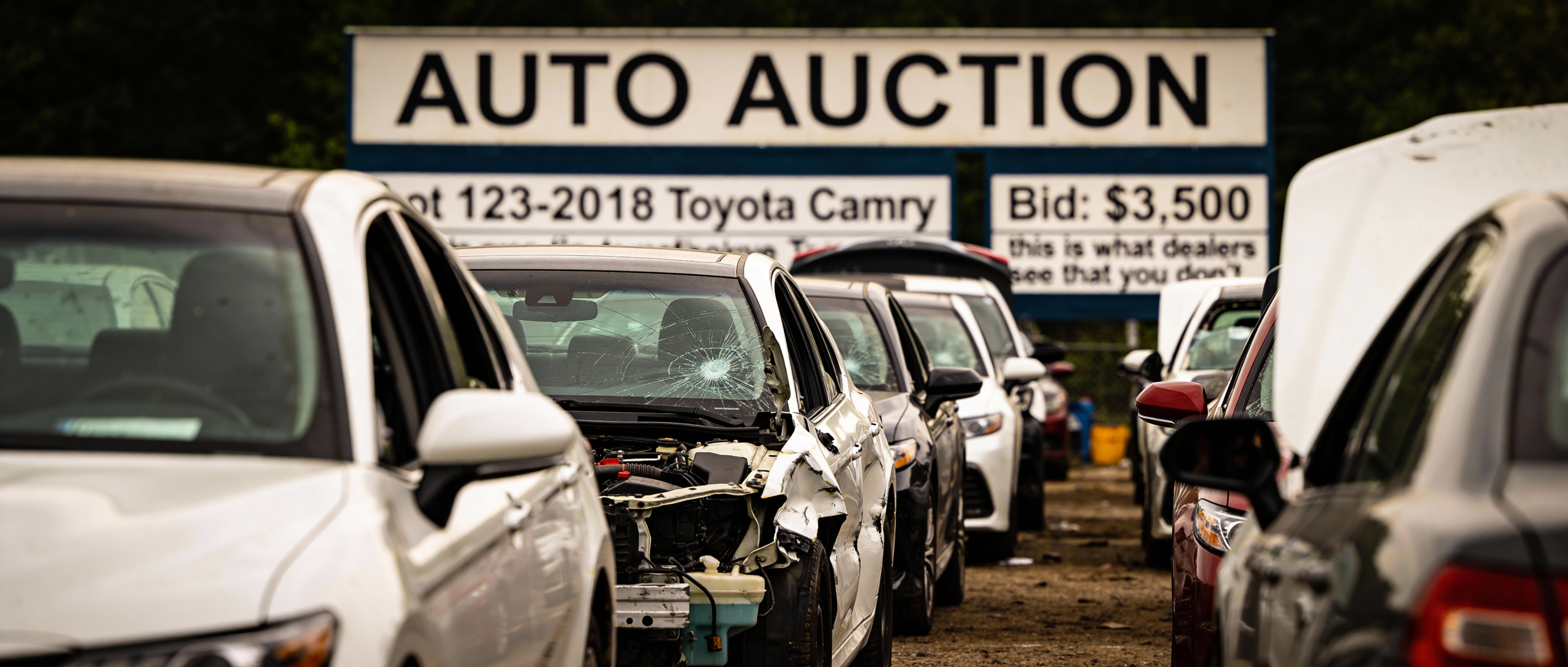
This is perhaps the biggest gap between traditional vehicle history reports and what's now possible in 2026. Auction intelligence reveals what dealers know—and what they'd rather you didn't.
What Happens at Auto Auctions
Many used vehicles pass through wholesale auctions (Copart, IAAI, Manheim) before reaching retail lots. At these auctions, vehicles are thoroughly documented:
- Detailed condition photos showing all damage
- Professional damage assessments
- Estimated repair costs
- Actual sale prices (what the dealer paid)
- Title status and announcements
Dealers use this information to make informed purchasing decisions. Then they fix the vehicle, detail it, and sell it to you without sharing any of this intelligence.
Why Auction Photos Matter
A vehicle might look perfect on the dealer lot, but auction photos from six months ago tell a different story. That pristine paint? It was covering $8,000 in hail damage. That clean interior? The auction photos showed flood water lines on the seats.
Disclosure Gap
Comprehensive vehicle history reports in 2026 can flag when a dealer's listing description doesn't mention damage that appears in the auction record. This "disclosure gap" is a significant red flag.
Dealer Cost Intelligence
Knowing what the dealer paid at auction completely changes your negotiating position. If they bought a vehicle for $12,000 at auction and listed it for $22,000, you have leverage. If they paid $19,000 and listed it for $22,000, the margin is tighter.
This is intelligence that traditional vehicle history reports never provided—but the AI revolution has made it accessible to regular buyers.
Financial Intelligence: Market Value and Ownership Costs
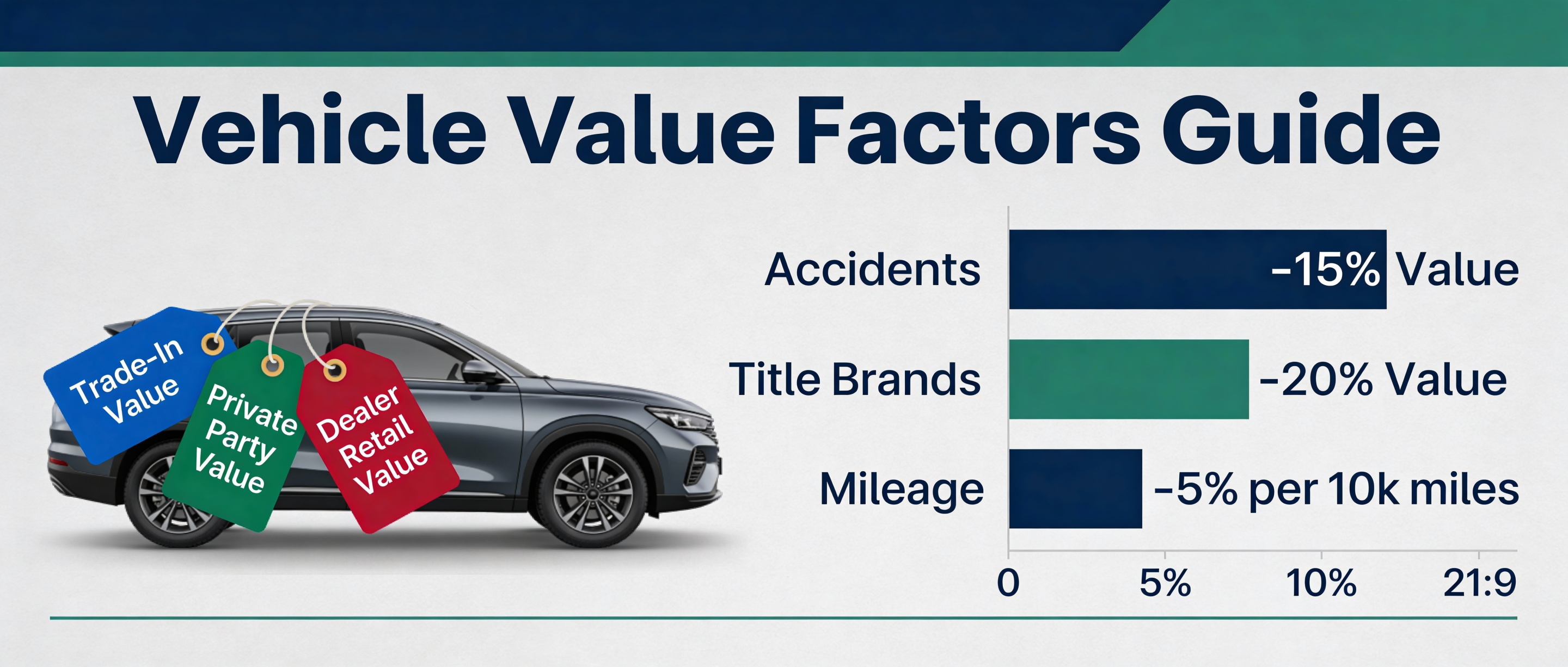
Vehicle history reports in 2026 should go beyond just listing problems—they should help you understand the financial implications of what you're buying.
Market Value Assessment
Comprehensive reports provide market values adjusted for the vehicle's actual condition:
- Trade-In Value: What a dealer would pay you
- Private Party Value: Fair price between individuals
- Dealer Retail Value: What dealers typically charge
Critically, these values should be adjusted for the vehicle's specific history—not just generic values for the year/make/model.
Target Price Range
AI-powered vehicle history reports can calculate a target price range based on all known factors: title status, accident history, mileage, condition, and market data. This gives you a specific number to negotiate from, not a vague sense of "fair pricing."
Ownership Cost Projections
What will this vehicle cost to own? Advanced reports estimate:
- Annual maintenance costs (by vehicle class)
- Expected repair costs based on make/model reliability
- 3-year and 5-year total ownership cost projections
- Comparison to class averages
Known Repair Estimates
For vehicles with identified issues, reports should provide repair cost estimates. If the AI analysis identifies that this model commonly needs transmission work at this mileage, you should know that could cost $3,000-$5,000.
Complete History Timeline: Every Event That Matters
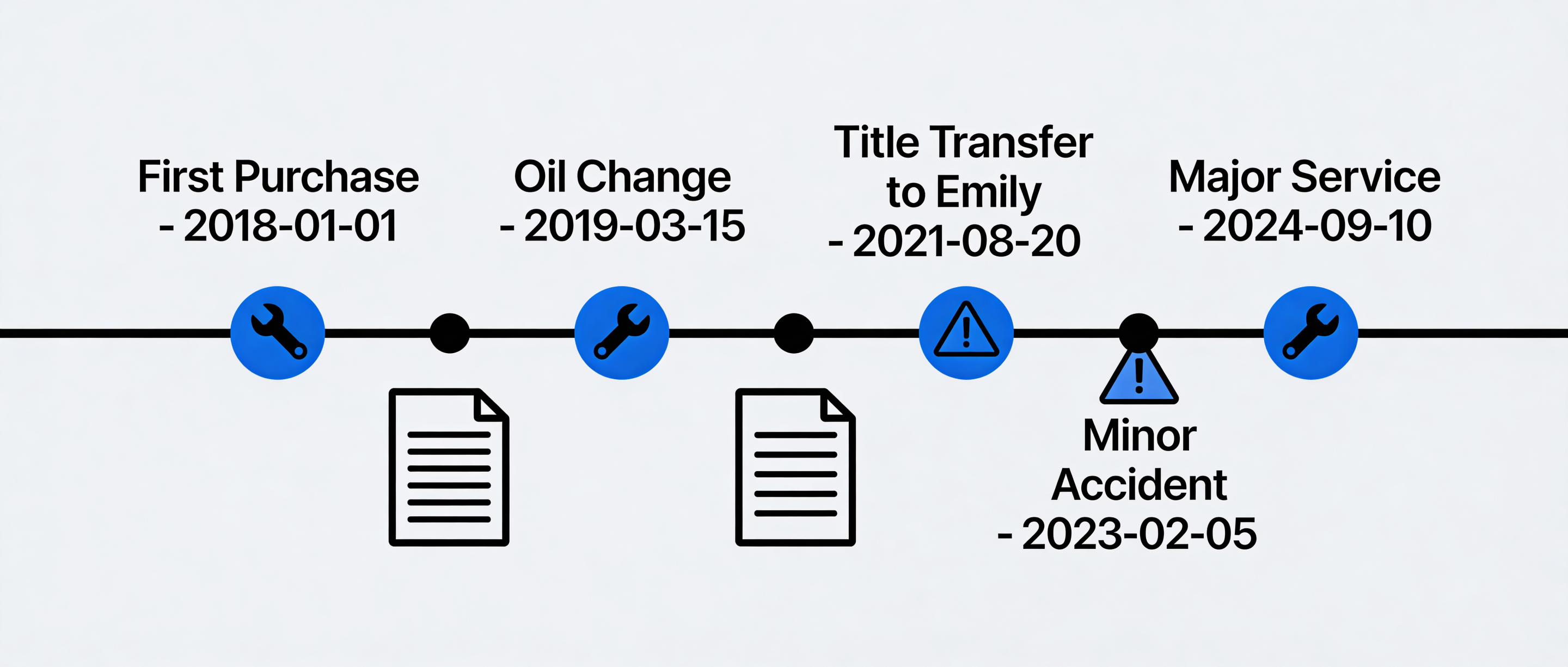
Beyond scores and analysis, your vehicle history report should provide a complete chronological timeline of every documented event in the vehicle's life.
Event Types to Expect
- Title Events: Registration, ownership transfers, title brands
- Service Records: Oil changes, maintenance, repairs
- Accident Reports: Collisions, damage claims
- Inspection Records: Emissions tests, safety inspections
- Auction Records: Wholesale sales, condition reports
- Dealer Listings: When and where the vehicle was listed for sale
- Mileage Readings: Odometer records over time
Visual Severity Coding
Modern vehicle history reports in 2026 use visual coding to help you quickly identify important events:
- Green: Service records, routine maintenance
- Gray: Neutral events, registrations
- Orange: Warning events, accidents, damage
- Red: Critical events, salvage, structural damage
Mileage Verification
Odometer fraud still exists. Your report should track mileage readings over time and flag any inconsistencies—like a vehicle that showed 120,000 miles three years ago but now shows 65,000 miles.
Inspection Recommendations: Know Before You Go
Even the most comprehensive vehicle history report cannot replace a physical inspection. But intelligent reports in 2026 can tell you what level of inspection you need.
Inspection Severity Levels
| Level | When It Applies |
|---|---|
| CRITICAL | Safety concerns, salvage title, or structural damage detected. Do not purchase without thorough professional inspection. |
| STRONGLY ADVISED | Multiple concerns or low safety/reliability scores. Professional inspection highly recommended. |
| RECOMMENDED | Some factors warrant attention. Pre-purchase inspection recommended as due diligence. |
| SUGGESTED | No significant concerns. Standard pre-purchase inspection suggested. |
| OPTIONAL | All categories score high. Inspection optional—available data shows no concerns. |
Specific Inspection Priorities
AI-powered reports don't just recommend inspection—they tell the mechanic what to focus on. If the report identified a moderate accident in the vehicle's history, the inspection should prioritize checking frame alignment and suspension components.
Questions to Ask the Seller
Vehicle history reports in 2026 should generate specific questions based on findings:
- "Can you provide documentation for the repairs completed after the 2023 accident?"
- "Why was this vehicle sold at auction twice in 18 months?"
- "What caused the 2-year gap in service records between 2021 and 2023?"
- "Has the transmission been serviced? This model commonly has issues at this mileage."
What Complete Vehicle Intelligence Actually Looks Like
By now, you understand what vehicle history reports in 2026 should provide. The AI revolution has made it possible to transform raw data into actionable intelligence. But let's be clear about what "complete" actually means.
A truly comprehensive vehicle history report gives you:
Complete Vehicle Intelligence Includes:
- AI-powered analysis that interprets data and explains what it means
- Confidence scores across Safety, Reliability, Ownership, and Value
- Auction photos and dealer purchase prices
- Estimated repair costs based on damage assessments
- Warranty status calculation with remaining coverage
- Make/model-specific issue research for the vehicle's mileage
- Market value adjusted for actual vehicle history
- Target price range for negotiation
- Ownership cost projections
- Complete event timeline with severity coding
- Mileage verification and fraud detection
- Inspection level recommendation
- Specific questions to ask the seller
- Disclosure gap detection for dealer listings
This is the standard for vehicle history reports in 2026. This is what the AI revolution has made possible. And this is what you deserve before making one of the largest purchases of your life.
The only thing better than complete vehicle intelligence is getting under the hood with a professional mechanic for an in-person inspection. But armed with the right report, you'll know exactly what that mechanic should look for—and whether the inspection is even worth your time and money.
There Is Only One Clear Solution
Everything described in this guide—AI analysis, confidence scores, auction intelligence, warranty status, value assessment, and actionable guidance—exists in one place.
VinPassed Delivers Complete Vehicle Intelligence.
Get Your Report Now
Frequently Asked Questions About Vehicle History Reports

Absolutely. A comprehensive vehicle history report costs $15-30 and can save you thousands by revealing hidden problems, title issues, or accident damage. The question isn't whether to get a report—it's whether to get one with complete vehicle intelligence including AI analysis and auction data, or a basic report that just lists events without interpretation.
The best vehicle history report in 2026 provides AI-powered analysis, confidence scoring across multiple categories, auction photos and dealer purchase prices, warranty status, and actionable guidance—not just a raw data dump. Look for reports that interpret the data and tell you what it means, not just what happened.
A complete vehicle history report should include: title history across all 50 states, accident and damage records, service history, ownership count and usage type, recall status, auction history with photos, market value assessment, mileage verification, and AI analysis that explains what all this data means for the specific vehicle you're considering.
A vehicle history report will show reported accidents from insurance claims, police reports, and inspection records. However, not all accidents are reported. Look for reports that also include auction photos and damage assessments, which often reveal damage that never made it into official records. Physical inspection by a mechanic can identify signs of unreported repairs.
Free VIN checks exist but provide very limited information—typically just basic specs, open recalls, and theft status from NMVTIS. They don't include accident history, service records, auction data, or AI analysis. For a vehicle purchase of $10,000-$50,000, investing $15-30 in a comprehensive report is essential due diligence.
A clean title means the vehicle has no damage-related title brands (salvage, rebuilt, flood, fire, lemon) on record. However, "clean title" doesn't mean "no problems." A vehicle can have a clean title and still have accident history, mechanical issues, or high mileage. That's why comprehensive vehicle history reports provide analysis beyond just title status.
Vehicle history reports track odometer readings from service records, inspections, registrations, and auction records over time. Any inconsistency—like lower mileage appearing after higher mileage was recorded—indicates potential fraud. Look for reports that specifically flag odometer discrepancies and verify mileage against multiple sources.
A salvage title means an insurance company declared the vehicle a total loss—typically when repair costs exceed 70-80% of the vehicle's value. Salvage vehicles can be repaired and re-titled as "rebuilt," but they carry permanently reduced value (30-40% less than clean title equivalents) and may have hidden damage that affects safety and reliability.
Most traditional vehicle history reports don't include auction photos. Advanced reports that provide complete vehicle intelligence include photos from wholesale auctions (Copart, IAAI) showing the vehicle's condition when dealers purchased it—often revealing damage that's since been repaired and hidden from buyers.
If a vehicle passed through wholesale auction, that sale price is recorded. Vehicle history reports with auction intelligence show what dealers paid, giving you powerful negotiating leverage. Knowing a dealer paid $12,000 at auction for a car listed at $22,000 completely changes the conversation.
It depends on the severity. Minor accidents with cosmetic damage may be acceptable at a reduced price. Major accidents involving structural damage or airbag deployment warrant extreme caution and professional inspection. A comprehensive vehicle history report should tell you the severity, estimate value impact, and recommend an appropriate inspection level.
Vehicle history reports compile data from thousands of sources including DMVs, insurance companies, service shops, auctions, and inspection stations. They're highly accurate for what's reported—but not all events get reported. Cash repairs, private sale damage, and unreported incidents won't appear. That's why reports should always be combined with physical inspection.
About This Guide: This article explains what comprehensive vehicle history reports 2026 should include and how AI-powered analysis has transformed the industry. VinPassed provides complete vehicle intelligence including all features described in this guide.
Last Updated: January 2026