Free VIN Check: Run One Instantly + 5 Powerful Facts Every Buyer Must Know
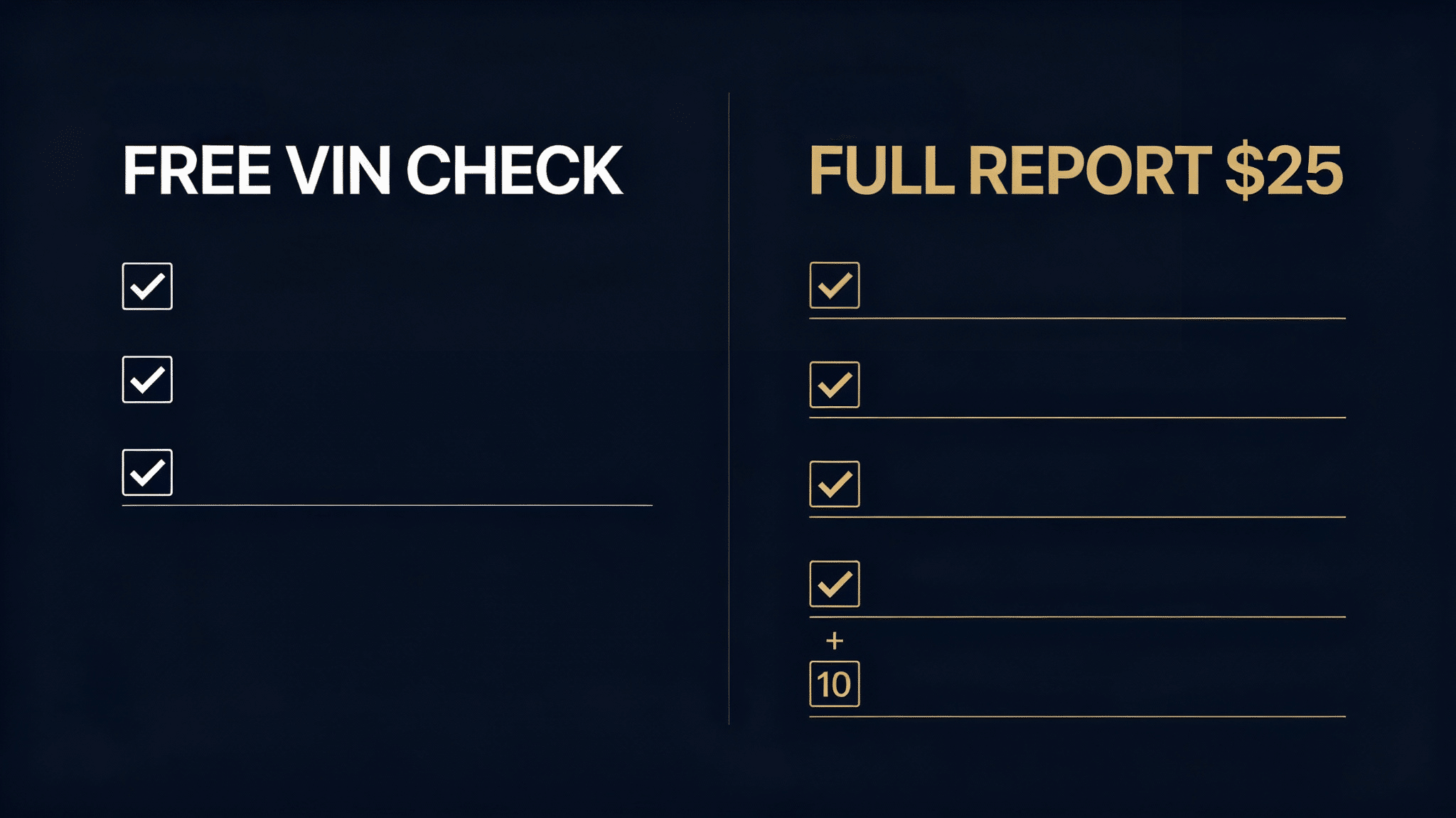
You can run a real free VIN check right here, right now. No email required. No paywall after you enter your number. The tool below pulls directly from NHTSA federal data and returns open safety recalls, crash test ratings, and vehicle specifications in seconds.
But before you run it, read this one paragraph so you know exactly what you are about to get: a free VIN check shows government-maintained safety data only. It does not show accidents, title brands, auction history, ownership records, or what the dealer paid. That data is privately maintained and not available for free anywhere. We will explain exactly why below, and show you the cheapest path to each piece you actually need.
Every used car buyer starts with the same instinct: run a free VIN check before spending money on a full report. That instinct is correct. A free VIN check is a legitimate and worthwhile first step. The problem is knowing precisely what that step covered and what it left unanswered, so you can decide how much further you need to go before you hand over a check.
Run Your Free VIN Check Here
This free VIN check tool is powered by NHTSA federal data, the same source used by every legitimate recall lookup in the United States. Enter your 17-character VIN from the dashboard, door jamb, or title document. You will get the complete public record for this vehicle: every open safety recall, every NHTSA crash test rating, and the specifications decoded from the VIN itself. That is the full scope of what a free VIN check from a government source can return.
Free VIN Check: Powered by NHTSA
Enter your VIN for instant federal data
Returns: recalls · safety ratings · specs · complaints | No signup required
What a Free VIN Check Actually Shows You
The results above are the complete output of a free VIN check from a federal source. A free VIN check is accurate for what it covers. Let's be precise about what each piece means so you can use it correctly.
Open recalls are safety defects that the manufacturer has been ordered to fix at no cost to you. If your results show open recalls, the selling dealer is required to disclose them and the manufacturer is obligated to repair them free of charge. A recall-free result means no outstanding federal safety orders, not that the vehicle has no problems.
Safety ratings are NHTSA crash test scores from controlled laboratory conditions. Five stars is the highest. These are model-level ratings, meaning every vehicle of that year, make, and model receives the same score. They reflect how well the vehicle's design protects occupants in a standardized crash, not the condition of the specific car you are looking at.
Consumer complaints are also model-level. They represent issues other owners of the same vehicle have reported to NHTSA, not documented problems with your specific VIN. A high complaint count for a particular component is worth noting when you have the car inspected.
Vehicle specifications are decoded from the VIN structure itself: engine, drivetrain, body style, country of manufacture. These confirm what the car is supposed to be, which is worth verifying against what the dealer is claiming. This is everything a free VIN check can decode from the VIN. It is accurate, it is useful, and it is genuinely free. What comes next in this article explains what it cannot reach.
The 2 Legitimate Free Sources and Their Real Limits
Beyond the NHTSA tool above, only one other government-linked source qualifies as a legitimate free VIN check: the NICB VINCheck. Every other site claiming to offer a free VIN check or free vehicle history is repackaging the same two datasets, presenting a teaser, or worse. Here is the honest breakdown of both.
Run a free VIN check above, or directly at nhtsa.gov/recalls
✓ What it covers:
Open safety recalls by VIN, NHTSA crash test safety ratings, vehicle specifications, consumer complaint patterns by model year
✗ What it does not cover:
Individual vehicle accidents, damage history, title brands, ownership records, auction records, odometer history. Complaints and ratings are model-level, not specific to your VIN.
Run a free VIN check at nicb.org/vincheck, National Insurance Crime Bureau
✓ What it covers:
Vehicles reported stolen and not yet recovered; total loss declarations submitted by participating insurance carriers
✗ What it does not cover:
Accidents, partial claims, damage repaired without an insurance report, total losses from non-participating carriers. Carrier participation is voluntary, so gaps exist even for catastrophic write-offs.
The Honest Truth About a Free VIN Check From NICB
NICB shows two things only: stolen vehicles not yet recovered, and total loss write-offs from participating carriers. If an insurer is not in the NICB network, their total losses do not appear here. A flood car declared a write-off by a non-participating carrier shows clean on NICB. Minor accidents never appear at all. A clean NICB result means no catastrophic write-off on record with participating insurers. It does not mean no accidents, and it does not mean the title is clean.
Running a free VIN check through both NHTSA and NICB takes under two minutes combined and costs nothing. Do it for every car you are seriously considering. Think of a free VIN check as a filter, not a verdict: it removes the worst-case government-flagged scenarios. Everything below that surface requires a paid provider with data licensing agreements that no free source can replicate. Then decide how much further you need to go based on what the decision is actually worth to you.
The 5 Things No Free VIN Check Can Ever Show You
This is the most important section of this article. A free VIN check delivers real value, but it leaves five critical questions unanswered. Understanding those gaps, and why no free VIN check can fill them, will tell you exactly how much further you need to go before you buy.
1. Accident History
There is no free source for accident records anywhere. A free VIN check through NHTSA or NICB does not include a single accident event, because those records are not government data. Accident information flows from insurance companies to private aggregators like LexisNexis and Verisk, who charge for access. Carfax and AutoCheck license that data and pass the cost to consumers. No publicly funded equivalent exists. The government tracks safety defect patterns across vehicle models, not what happened to individual cars on individual roads. Any site claiming to offer a free accident check is showing you something else and calling it an accident report.
2. Title Brands Across All States
Salvage titles, rebuilt titles, flood titles, and lemon law buyback brands are legally required disclosures when a vehicle transfers ownership. But they are recorded at the state level, and title washing across state lines is a documented problem. The federal NMVTIS database aggregates title data nationally, but access requires a paid provider. A free VIN check does not reach NMVTIS. A $5 title and stolen check does, and it is the most direct answer to the question every buyer should ask first: is this title clean right now?
3. Auction Photos and Pre-Repair Condition
When a vehicle goes through an insurance auction or salvage sale, condition photos are taken before any repairs begin. These photos document the actual extent of damage before the bodywork, before the paint, before the car reached the dealer lot. No free VIN check carries auction photos. They exist only in private auction databases that paid providers license and access. If this vehicle has auction history, a $10 auction report reveals exactly what it looked like before it was cleaned up.
4. Dealer Acquisition Cost
Dealers buy used cars at auction, and that transaction price is recorded. It tells you what the dealer actually paid before markup, reconditioning, and profit margin. That number does not appear in any free VIN check or free database anywhere. When you know what a dealer paid, the negotiation is no longer a guess. You are working from documented numbers, not hoping you found a fair price.
5. Market Value, Cost of Ownership, and Confidence Score
Knowing what a car is worth right now, what it will cost to own over time, and a consolidated confidence score that weighs all available data against each other requires aggregating from dozens of independent sources simultaneously. No free VIN check touches any of this. VinPassed pulls from thousands of data points to deliver 12 independent market valuations, projected repair costs, upcoming maintenance milestones, and an AI-generated risk score. None of this exists in public data.
The False Confidence Problem
The most dangerous outcome of a free VIN check is not finding something wrong. It is feeling like you have done your homework when you have only checked a narrow slice of government data. A clean recall result and a clean NICB result can coexist with a flood-damaged title, a rolled odometer, and $8,000 in documented auction damage. The FTC recommends verifying full vehicle history before any used car purchase, not just checking a government registry.
The Truth About “Free” Carfax Reports
Once buyers accept that a basic free VIN check is not enough, most reach for Carfax. And the first question is always: can I get a free Carfax somewhere? The short answer: no. A free VIN check from NHTSA or NICB is genuinely free. A free Carfax is not a real thing.
The only context in which a Carfax report is free is at a dealership. Dealers pay Carfax for bulk access and offer those reports as a sales closing tool. When a dealer hands you a free Carfax, they paid for it, and their primary customer relationship with Carfax shapes what the report surfaces and what it buries. A dealer-provided Carfax is not independent due diligence. It is part of the sales process.
Outside of a dealership, no free Carfax exists. Sites offering downloadable free Carfax PDFs are operating against Carfax's terms of service. The data is expired, fabricated, or scraped from outdated cached records. None of it reflects the vehicle's current status and none of it is legitimate. A free VIN check from NHTSA or NICB is genuinely free and genuinely useful. A free Carfax is neither.
Carfax's retail price is $44.99 for a single report. See our full honest review of whether Carfax is worth it and our Carfax vs AutoCheck comparison for what each actually includes.
Warning: Fake, Scraped, and Illegal VIN Reports
The demand for a free VIN check has created a category of sites that exploit that demand without delivering anything legitimate. Knowing what to avoid protects you from bad information and potential scams.
Bait-and-Switch Paywall Sites
These sites accept your VIN, show you a spinning loader, display a partial result teaser, and then require payment to see any actual data. The "free VIN check" is a lead generation mechanism, not a real lookup. The data they sell is often sourced from the same two public databases you can access for free at NHTSA and NICB directly.
Scraped and Outdated Report Sites
Some sites present what appears to be a full vehicle history report without charging for it. When buyers search for a free VIN check and land on these pages, the data is almost always scraped from publicly visible partial records, cached months or years ago, and reassembled to look like a current report. A vehicle that acquired a salvage title last month will show clean on these sites. Acting on outdated data is more dangerous than having no data at all.
Illegal Carfax and AutoCheck PDF Downloads
Sites and forums that offer downloadable Carfax or AutoCheck reports are distributing licensed proprietary data in violation of those companies' terms of service. Even setting aside the legal dimension, these PDFs are copies of reports pulled at an unknown date. A report from 18 months ago does not reflect what has happened to that vehicle since. It may have been in three accidents, declared a total loss, and title-washed across two states in the time since that PDF was generated.
Aggregator Sites With No Data Agreements
Some sites present a professional interface and claim to aggregate from multiple sources without disclosing what those sources actually are. Legitimate vehicle history providers have data licensing agreements with insurance carriers, auction houses, state DMV systems, and NMVTIS-authorized data suppliers. Without those agreements, the data is either fabricated or repackaged public data dressed up to look like intelligence. Running a free VIN check on one of these sites gives you the false confidence of having done research without the substance.
The Only Legitimate Free VIN Check Sources
NHTSA for recalls and safety ratings. NICB for stolen and total loss flags from participating carriers. A free VIN check from either of these sources is backed by real data. Everything else that calls itself a free vehicle history report is either a teaser, a scam, or outdated data that could create false confidence at exactly the wrong moment.
The Complete Data Hierarchy: Free to Full
Here is exactly what each level of research costs and what it tells you, starting from the free VIN check you already ran above. Every tier builds on the one before it, and whatever you spend at any tier applies toward the full report if you decide you need more.
Open recalls, safety ratings, vehicle specs, stolen flag, and total loss declarations from participating carriers.
A genuine free VIN check. Run both NHTSA and NICB. Takes two minutes and costs nothing. Tells you nothing about this vehicle's individual accident history, title brands, auction record, or what it has been through.
Title brand check across all 50 states + stolen vehicle verification beyond NICB's participating-carrier limitation.
The first step beyond a free VIN check. Tells you whether damage was ever severe enough to brand this title: salvage, rebuilt, flood, lemon law buyback. If the title is clean, you know before spending more. If it is not, you know before making an offer.
Auction Report: pre-repair condition photos, damage grade, and what the dealer actually paid at auction.
For buyers who want to go further than a free VIN check or title check. If this vehicle passed through an insurance or salvage auction, you see the photos from before it was repaired and the price the dealer paid. What auction photos reveal about hidden damage.
Complete Vehicle Intelligence: full accident history, all title records, ownership chain, odometer verification, 12 market valuations, cost of ownership, maintenance schedule, AI confidence score.
Everything a free VIN check cannot show you, in one report. Same accident data pipeline as Carfax and AutoCheck, plus auction photos, dealer acquisition cost, and data points Carfax does not surface. More information than any other provider at a lower price.
Five complete reports for buyers actively shopping multiple vehicles. $18 per report. Reports never expire.
Run the free VIN check on every car. Use these five reports to go deep on your shortlist. $18 each with no expiration. Use them on any VIN, any time, at your own pace. See full pricing and packages.
Your Paid Amount Is Never Wasted
Start with the free VIN check above. Then step up only as far as the decision requires. Whatever you spend at the $5 or $10 tier applies toward the full $30 report if you decide you want the complete picture. You are not paying twice. You are building on what you already spent.
What VinPassed Shows That Free Sources Cannot
The tool at the top of this article ran a legitimate free VIN check using NHTSA federal data. Here is a side-by-side of what a free VIN check actually returns versus what each paid tier adds. The highlighted rows are data points that no free source can reach under any circumstances:
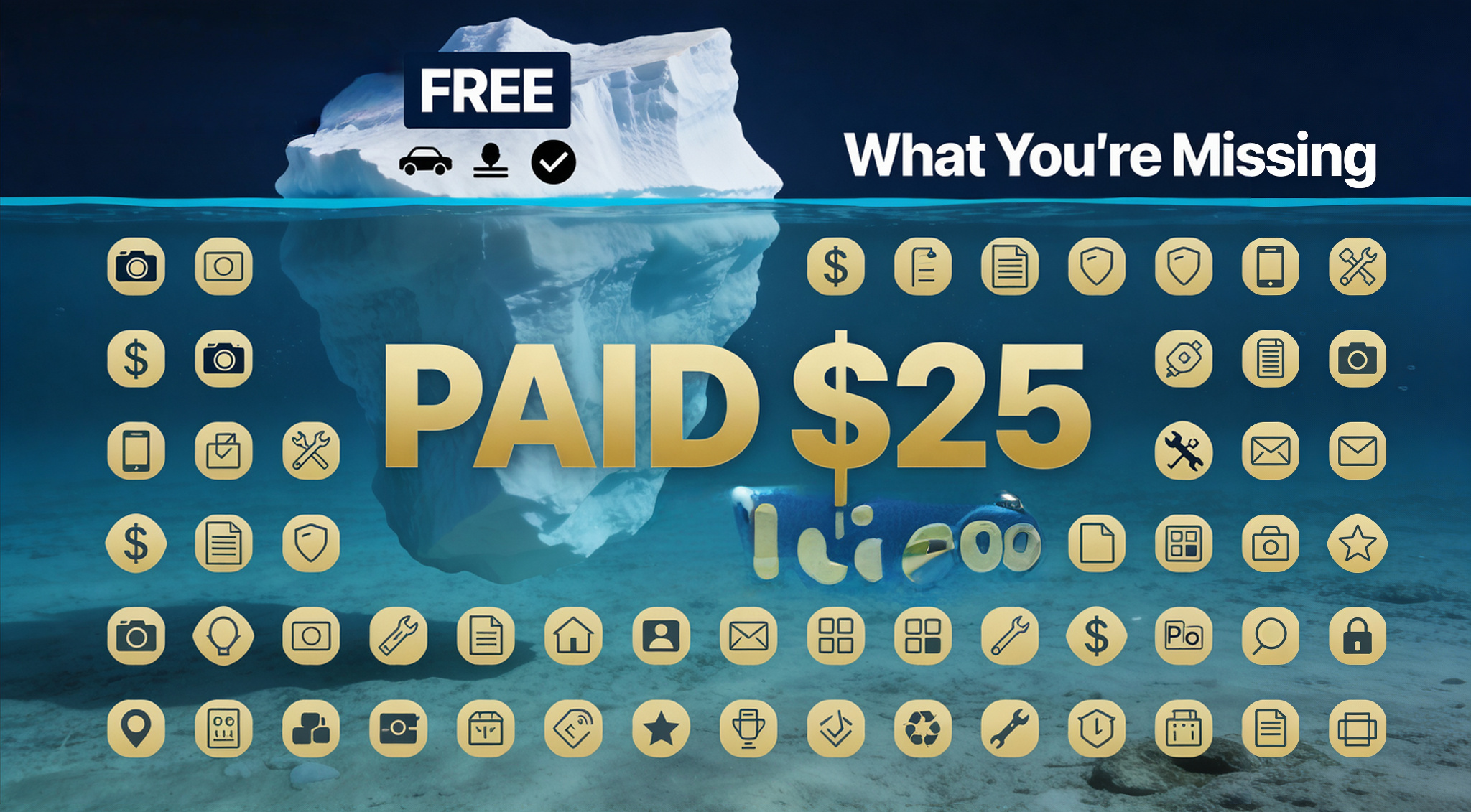
| Data Type | NHTSA | NICB | $5 Title Check | $10 Auction | $30 Complete |
|---|---|---|---|---|---|
| Vehicle Specs | ✓ | ✗ | ✓ | ✓ | ✓ |
| Open Recalls | ✓ | ✗ | ✗ | ✗ | ✓ |
| Safety Ratings | ✓ | ✗ | ✗ | ✗ | ✓ |
| Stolen Flag | ✗ | ✓ partial | ✓ full | ✓ full | ✓ full |
| Total Loss (insurers) | ✗ | ✓ partial | ✗ | ✗ | ✓ |
| Title Brands (all states) | ✗ | ✗ | ✓ | ✗ | ✓ |
| Auction Photos | ✗ | ✗ | ✗ | ✓ | ✓ |
| Dealer Acquisition Cost | ✗ | ✗ | ✗ | ✓ | ✓ |
| Accident History | ✗ | ✗ | ✗ | ✗ | ✓ |
| Market Value (12 sources) | ✗ | ✗ | ✗ | ✗ | ✓ |
| Cost of Ownership | ✗ | ✗ | ✗ | ✗ | ✓ |
| AI Confidence Score | ✗ | ✗ | ✗ | ✗ | ✓ |
| Price | Free | Free | $5 | $10 | $30 |
3 Real Cases Where a Clean Free VIN Check Failed the Buyer
These scenarios illustrate why a clean free VIN check is not the same as a clean vehicle. In each case, the government databases returned nothing alarming. In each case, the full picture was very different.
The "Clean" BMW That Wasn't
NHTSA: recalls resolved. NICB: no theft flag, no total loss. The free VIN check showed nothing alarming. Buyer felt confident.
Full report revealed two separate accident events with $8,400 in documented auction damage. Prior salvage auction appearance with title washing across state lines. The NICB clean result was accurate because no participating carrier had filed a total loss. The car had still been rebuilt and resold as if nothing had happened.
Cost of skipping the full report: A $22,000 purchase that required immediate structural repair.
The Overpriced Honda Nobody Wanted
NHTSA: nothing alarming. NICB: clean. The free VIN check gave the buyer no reason to hesitate.
Full report revealed the dealer had paid $12,500 at auction and was asking $19,500. The vehicle had been listed at three dealerships over 78 days with two price reductions. The market kept passing on it and the buyer had no idea why until they saw the acquisition cost.
Using dealer cost data: Buyer negotiated to $15,500 and walked away with $4,000 still in their pocket.
The Flood Car With a Clean Free Result
NICB: not stolen, no total loss. The free VIN check showed nothing. Buyer nearly signed.
Full report revealed auction photos showing a visible waterline on the seats. Louisiana salvage auction post-hurricane. Extensive flood damage documented in the auction record, never submitted to any participating insurer, so NICB had nothing to show.
The result without the full report: A flood car with a $10,000-plus electrical problem the buyer would have spent years diagnosing.
Start with the biggest gap
You ran the free VIN check above. Now find out if this title is clean.
$5 title and stolen check · $10 auction report with photos · $30 complete intelligence · Anything paid applies toward the full report
Check Title Status for $5 →Protecting Yourself After Purchase
A complete vehicle history report covers what happened before you bought. Running a free VIN check and stepping up to a paid report handles your pre-purchase research. Once you have done that homework and made the purchase, VIP Warranty offers exclusionary mechanical coverage for vehicles up to 250,000 miles, starting where pre-purchase research ends.
The Bottom Line on Free VIN Checks
A free VIN check is a legitimate and worthwhile first step. Run the NHTSA tool at the top of this page. Run NICB at nicb.org/vincheck. Both take under two minutes and cost nothing. You will have recalls, safety ratings, specs, and a stolen-vehicle flag. That is the complete scope of a free VIN check from authoritative sources.
Then be honest about what the free VIN check still did not answer: title status, accidents, auction history, dealer cost, market value, and confidence score. Those gaps represent real financial risk on a purchase that likely costs $10,000 to $40,000.
The $5 title check tells you whether the title is clean right now. It does not tell you the full story, but it tells you the current page. The $10 auction report shows you what the car looked like before it was cleaned up and what the dealer paid. The $30 complete report gives you everything a free VIN check cannot, and anything you spent on the lower tiers applies toward it.
For buyers shopping multiple cars, five complete reports for $90 is $18 each. Reports never expire. Use them at your own pace across your entire search. That is less than one tank of gas to know exactly what you are buying before you sign.
Free VIN Check + Full Intelligence
Run the free VIN check above. Then go as deep as the decision requires.
$5 title check · $10 auction report · $30 complete · $90 for 5 reports at $18 each
See All VinPassed Packages →Frequently Asked Questions
Is there a completely free VIN check that shows everything?
No. A legitimate free VIN check from NHTSA returns recalls, safety ratings, and vehicle specs. NICB returns a stolen flag and total loss declarations from participating insurers only. Neither shows accident history, title brands, ownership records, auction data, or dealer cost. Those datasets are privately maintained and not available for free anywhere. Any site claiming to offer a free full vehicle history report is either showing you a VIN decode repackaged as a report, or presenting a teaser designed to hit you with a paywall after you enter your VIN.
What does a free VIN check actually show?
A free VIN check through NHTSA shows open safety recalls by VIN, crash test safety ratings, vehicle specifications, and consumer complaint patterns by model year. A free VIN check through NICB shows whether the vehicle has been reported stolen and not recovered, and whether a participating insurance carrier declared it a total loss. Neither source shows accident history, damage records, title brands, ownership history, or auction records.
Does a free VIN check show accidents?
No. There is no free source for accident records anywhere. Accident data flows from insurance companies to private aggregators. NHTSA tracks safety defects by model, not individual vehicle accidents. NICB tracks total loss write-offs from participating carriers only. The cheapest way to check whether damage was severe enough to brand the title is a $5 title and stolen check. Full accident history requires a complete vehicle history report.
Can I get a free Carfax report?
No free Carfax report exists outside of a dealership context. When a dealer offers you a free Carfax, they paid for it as a sales tool. Sites claiming to offer free Carfax reports are distributing expired or fabricated data in violation of Carfax's terms of service. None of it reflects the vehicle's current status. A free VIN check from NHTSA or NICB is genuinely free. A Carfax report is not.
What is NICB VINCheck and how accurate is it?
NICB VINCheck is a free lookup run by the National Insurance Crime Bureau. It checks two things: whether a vehicle has been reported stolen and not recovered, and whether a participating carrier declared it a total loss. Carrier participation is voluntary, which means gaps exist even for catastrophic write-offs. A clean NICB result means no total loss was reported by a participating insurer. It does not mean no accidents, and it does not mean the title is clean.
What is the cheapest way to check a car's title?
A $5 title and stolen check from VinPassed is the cheapest meaningful way to verify title status. It runs a full title brand search across all 50 states, covering salvage, rebuilt, flood, lemon law buyback, and other brands. It also includes stolen vehicle verification beyond NICB's participating-carrier limitation. If the title is clean, you know before spending more. If it is not, you know before making an offer. Whatever you pay here applies toward the full $30 report.
Are free VIN check websites legitimate?
Only two free VIN check sources are backed by authoritative data: NHTSA for recalls and safety ratings, and NICB for stolen and total loss flags. Every other site claiming to offer a free full vehicle history report is repackaging limited public data, using bait-and-switch tactics, or presenting scraped and outdated information. Sites offering downloadable PDF Carfax reports for free are operating against Carfax's terms of service and the data is almost certainly expired or fabricated.
How much does a real vehicle history report cost?
VinPassed offers reports starting at $5 for a title and stolen check, $10 for an auction report with pre-repair photos and dealer cost data, and $30 for a complete vehicle intelligence report including full accident history, all title records, 12 market valuations, cost of ownership, maintenance schedule, and AI confidence score. A five-report bundle for buyers screening multiple vehicles is $90, which is $18 per report with no expiration. Any amount paid toward a lower tier applies toward the full report. See all packages at vinpassed.com/pricing.