Best VIN Check 2026: Complete Rankings & Expert Analysis
You're shopping for a used car. The listing looks clean. The price seems fair. But before you hand over $15,000, $25,000, or more — you need to know what you're actually buying.
That's where a VIN check comes in.
The problem? There are dozens of services claiming to offer the "best VIN check." Some cost $45. Others cost $10. A few are free. And the differences between them could cost you thousands.
We tested every major VIN check service to find the best VIN check 2026 has to offer. We ran identical VINs through each platform, compared data accuracy, and analyzed what each service shows — and hides.
Here's what we found.
Quick Answer: Best VIN Check 2026
| Rank | Service | Price | Best For |
|---|---|---|---|
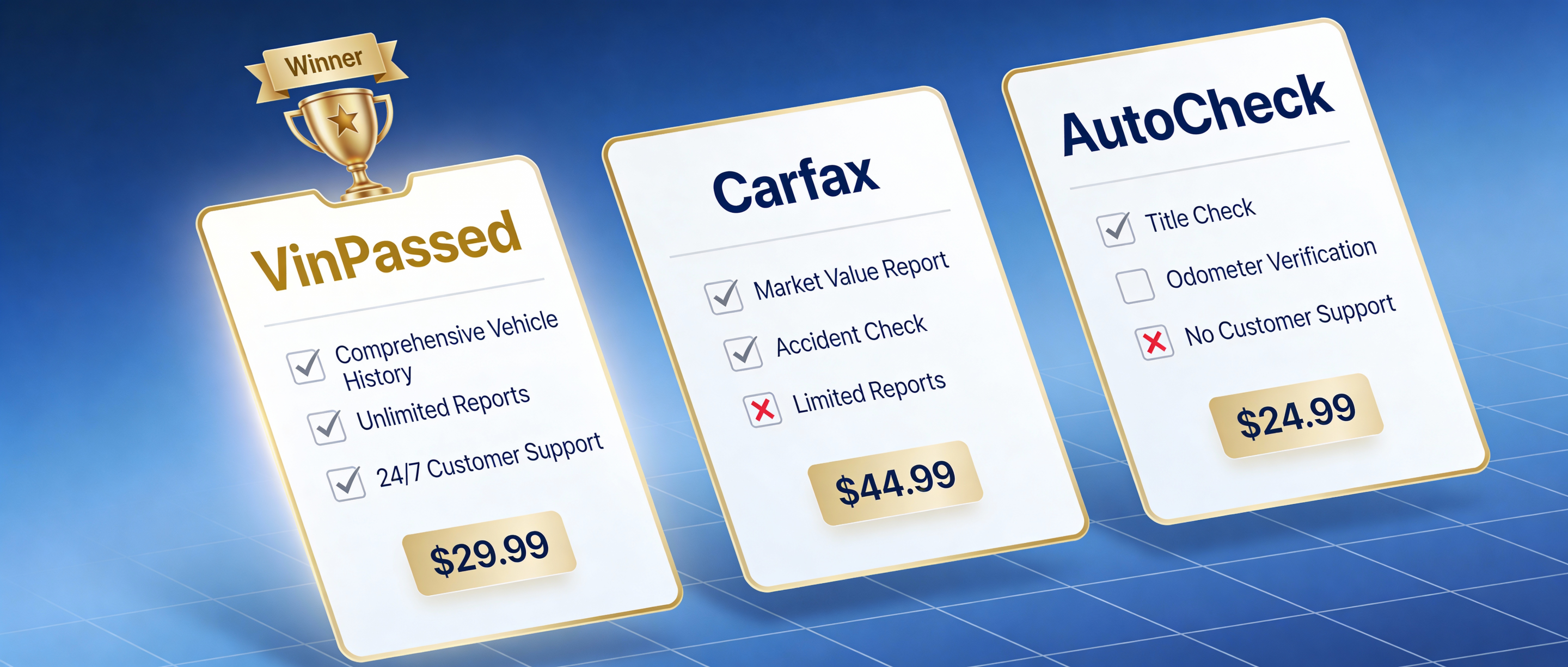
| #1 | VinPassed | $29.99 | Most complete data + AI analysis |
| #2 | Carfax | $44.99 | Brand recognition (when free from dealer) |
| #3 | AutoCheck | $24.99 | Budget + AutoCheck Score |
| #4 | VinAudit | $9.99 | Basic NMVTIS on a budget |
| #5 | EpicVIN | $14.99+ | Subscription users |
How We Ranked the Best VIN Check 2026 Services
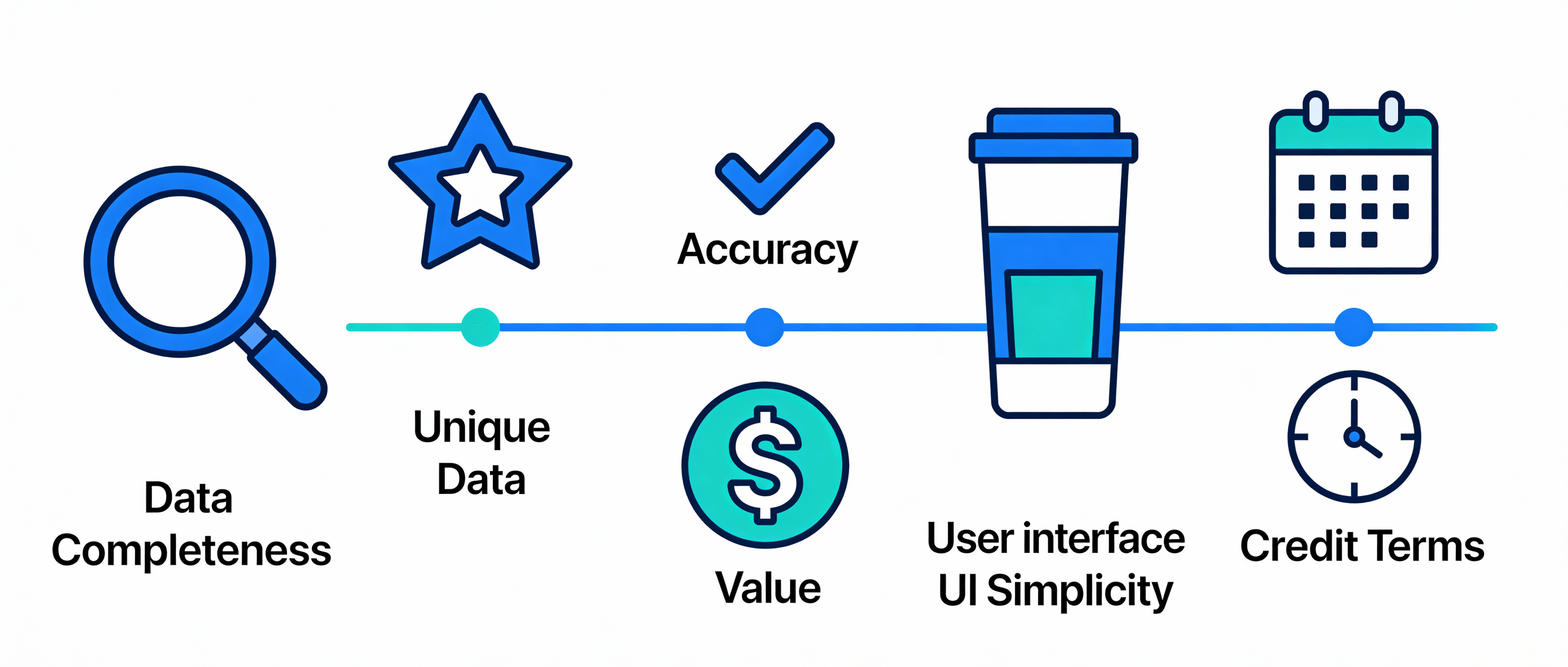
We evaluated each service across six categories:
- Data Completeness (25 pts) — How much information does the report include?
- Unique Data (20 pts) — Does it offer data competitors don't have?
- Accuracy (20 pts) — How reliable is the information?
- Value (15 pts) — What do you get for the price?
- Usability (10 pts) — How easy is the report to understand?
- Credit Terms (10 pts) — Do credits expire? Multi-report pricing?
We ran the same VINs through multiple services and compared results side-by-side.
The Best VIN Check 2026: Complete Rankings
VinPassed — Best VIN Check 2026 Overall
Why #1
VinPassed earns the best VIN check 2026 ranking because it provides everything Carfax and AutoCheck offer — plus exclusive data they intentionally exclude.
When a vehicle sells at auction, it's photographed extensively. Those photos show dents, damage, and wear before any reconditioning. Carfax doesn't include auction photos. AutoCheck doesn't either. VinPassed does.
VinPassed also shows what the dealer paid at auction. If they paid $16,000 and they're asking $25,000, you know exactly how much room exists to negotiate.
Carfax — The Expensive Industry Standard
Why #2
Carfax built the vehicle history industry. They have strong brand recognition and the most extensive service record network. The buyback guarantee offers peace of mind.
The problem: Carfax is built for dealers, not buyers. Dealers pay up to $25/report to provide "free" Carfax as a sales tool. Would showing auction photos of pre-repair damage help dealers sell cars? No. So Carfax excludes this data by design.
When to use: Accept it free from dealers. Don't pay $45 when VinPassed offers more for $29.99.
AutoCheck — Mid-Range Experian Option
Why #3
AutoCheck is owned by Experian, the credit bureau giant. Their AutoCheck Score (0-100) lets you quickly compare vehicles. At $24.99, it's cheaper than Carfax for similar core data.
The problem: Credits expire in just 21 days. If you're shopping for more than three weeks, you'll pay again.
#4-10: The Rest of the Field
| Rank | Service | Price | Notes |
|---|---|---|---|
| #4 | VinAudit | $9.99 | Budget NMVTIS option, government data only |
| #5 | EpicVIN | $14.99+ | Subscription model ($49.99/mo unlimited) |
| #6 | Bumper | $1 trial | Slick UI, thin data per Edmunds testing |
| #7 | iSeeCars | Free/Paid | Good price analysis, limited history |
| #8 | ClearVin | $5.79+ | Budget NMVTIS alternative |
| #9 | NICB VINCheck | Free | Theft & salvage only — nicb.org/vincheck |
| #10 | NHTSA | Free | Recalls only — nhtsa.gov/recalls |
⚠️ Warning: VinCheckUp
Despite heavy Reddit/Quora promotion, VinCheckUp has 1.5 stars on Sitejabber and poor ratings on Trustpilot. Users report generic data, missing accident history, and refused refunds. We cannot recommend it.
Best VIN Check 2026: Feature Comparison
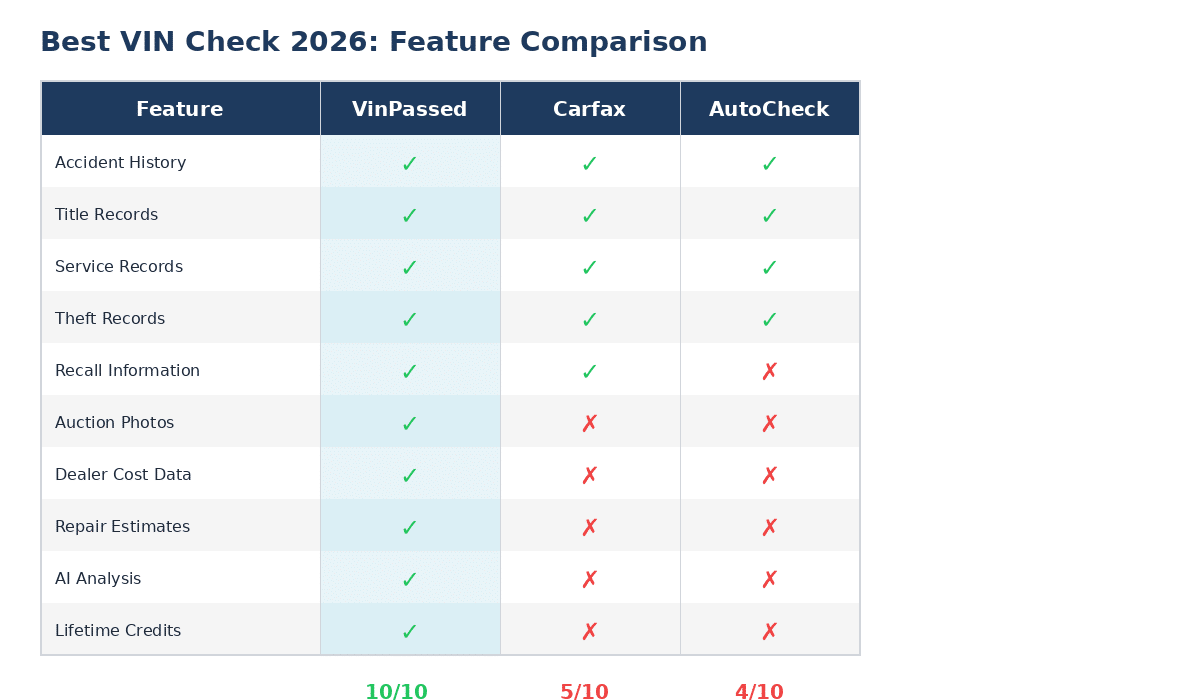
| Feature | VinPassed | Carfax | AutoCheck | VinAudit |
|---|---|---|---|---|
| Accident History | ✓ | ✓ | ✓ | Limited |
| Title Records | ✓ | ✓ | ✓ | ✓ |
| Service Records | ✓ | ✓ | ✓ | ✗ |
| Theft Records | ✓ | ✓ | ✓ | ✓ |
| Recalls | ✓ | ✓ | ✓ | ✓ |
| Auction Photos | ✓ | ✗ | ✗ | ✗ |
| Dealer Cost Data | ✓ | ✗ | ✗ | ✗ |
| Repair Estimates | ✓ | ✗ | ✗ | ✗ |
| AI Analysis | ✓ | ✗ | ✗ | ✗ |
| 10 Languages | ✓ | ✗ | ✗ | ✗ |
| Buyback Guarantee | ✗ | ✓ | ✗ | ✗ |
| Credit Expiration | Never | 60 days | 21 days | Never |
| Single Report | $29.99 | $44.99 | $24.99 | $9.99 |
| 5 Reports | $75 | $99.99 | $49.99 | ~$50 |
The Page 10 Problem: Why More Data Isn’t Better
Here's a dirty secret about vehicle history reports:
More data doesn't mean better protection.
How Most Buyers Use a VIN Check
- Open the report
- Read the front-page summary
- See "Clean Title" and "No Accidents Reported"
- Stop reading
- Buy the car
What They Miss
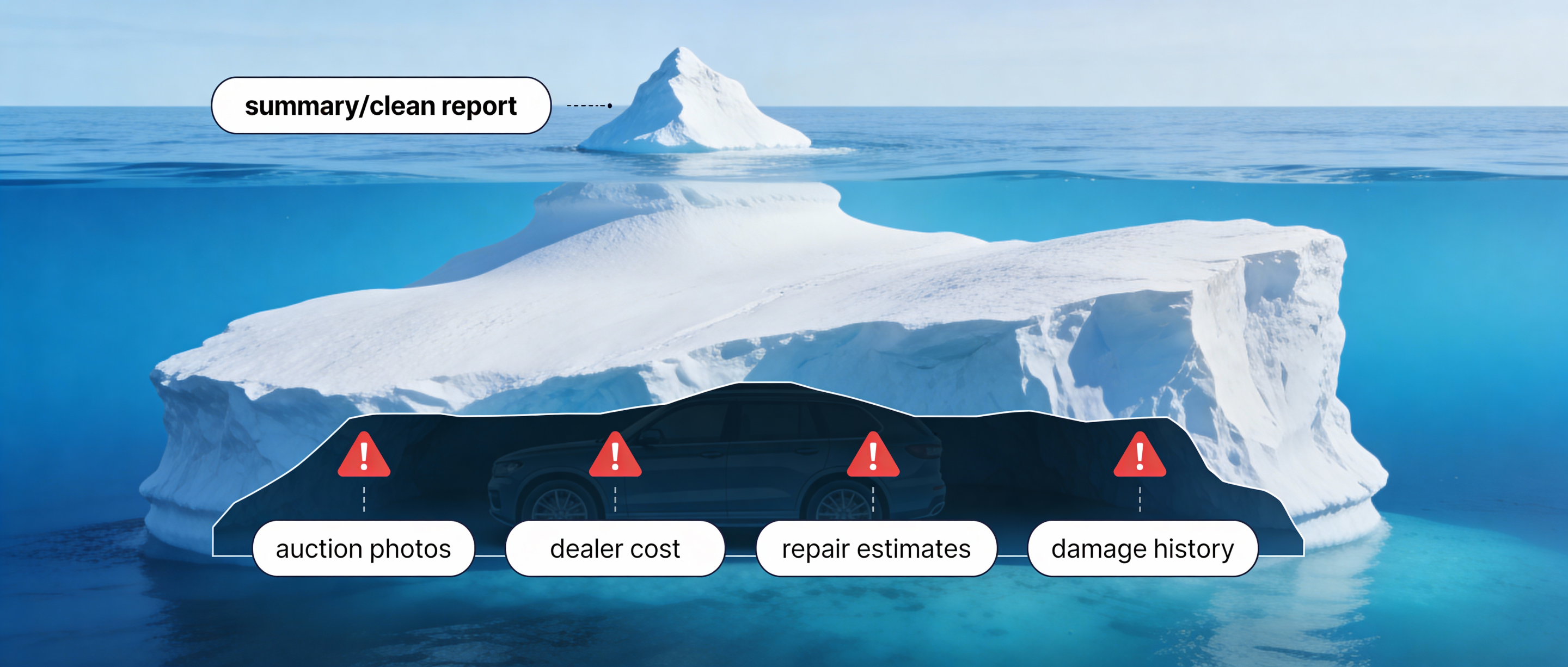
That salvage title brand buried on page 10? Not in the summary.
The auction photos showing a basketball-sized dent in the quarter panel? Carfax doesn't include photos. Neither does AutoCheck.
The fact that the dealer paid $16,000 at auction but listed it for $25,000? No traditional VIN check shows dealer cost.
And when that $16,000 auction vehicle needed $14,000 in repairs before resale? Only VinPassed shows estimated repair costs.
A $9,000 markup on a vehicle with hidden damage history isn't a deal. It's a trap.
Why Traditional Reports Hide Critical Data
Traditional vehicle history reports aren't built to protect you. They're built to:
- Satisfy a checkbox ("Yes, we ran a Carfax")
- Help dealers close sales (Carfax's real customers pay up to $25/report)
- Provide legal cover ("The information was available...")
The critical details exist. They're just buried in 40 pages of oil changes and tire rotations.
How VinPassed Solves This
VinPassed flips the model. Instead of hiding problems in data dumps, our AI analysis:
- Surfaces red flags first — not on page 37
- Shows auction photos — see damage before repairs
- Reveals dealer cost — know the real markup
- Calculates repair estimates — understand true damage severity
- Provides a Confidence Score — one number, full context
You don't need to be a car expert to understand what matters. The AI does that work for you — in 10 languages.
The Credit Expiration Trap
When comparing the best VIN check 2026 options, pricing per report is only half the story.
| Service | 5-Report Package | Expiration | Real Cost (2+ Month Search) |
|---|---|---|---|
| VinPassed | $75 ($15/each) | Never | $75 |
| Carfax | $99.99 ($20/each) | 60 days | $99.99+ |
| AutoCheck | $49.99 ($10/each) | 21 days | $99.98+ (must rebuy) |
| VinCheckUp | $49.95 ($5/each) | 30 days | $99.90+ |
💡 Pro Tip
AutoCheck's "cheap" 5-pack becomes expensive if your car search takes longer than 21 days. Most buyers take 2-3 months to find the right vehicle. VinPassed lifetime credits mean you pay once, use whenever — even if you pause your search for six months.
When Free VIN Checks Are Enough
Free options exist. Here's when they make sense:
Use NICB VINCheck (free) when:
- Quick theft/salvage screening before investing more time
- Initial filtering of multiple vehicles
Use NHTSA Recall Lookup (free) when:
- Verifying open safety recalls
- Already own the vehicle
Never rely solely on free checks for:
- Any vehicle over $5,000
- Negotiating price
- Private party purchases
- Any purchase where you need leverage
The FTC recommends always checking vehicle history before purchase. For anything over $5,000, the $29.99 investment is trivial insurance.
Best VIN Check 2026: The Bottom Line

For 2026, VinPassed is the best VIN check for most buyers because it provides:
- ✓ Everything Carfax shows (accidents, titles, service, recalls)
- ✓ Everything AutoCheck shows (history, verification)
- ✓ Plus auction photos revealing hidden damage
- ✓ Plus dealer cost for negotiating power
- ✓ Plus repair estimates showing true damage severity
- ✓ Plus AI-powered Confidence Score (100+ data points analyzed)
- ✓ Plus analysis available in 10 languages
- ✓ Plus lifetime credits that never expire
- ✓ At a lower price than Carfax ($29.99 vs $44.99)
Carfax remains useful when dealers provide it free — always accept free data. But don't pay $45 for a report designed to help dealers sell cars.
AutoCheck offers value at $24.99 with the AutoCheck Score, but 21-day credit expiration hurts buyers who take time to decide.
For the most complete data, the best value, and reports designed for buyers (not dealers), VinPassed is the best VIN check 2026 has to offer.
Get the Best VIN Check 2026
2 reports: $49.99 ($25 each) • 3 reports: $59.99 ($20 each) • 5 reports: $75.00 ($15 each)
All credits last forever. No 21-day pressure.
Best VIN Check 2026: Frequently Asked Questions
What is the best VIN check for 2026?
VinPassed ranks as the best VIN check 2026 because it includes everything competitors offer plus exclusive data: auction photos, dealer cost, repair estimates, and AI-powered analysis with a Confidence Score. At $29.99, it costs less than Carfax while providing more data.
Is Carfax still the best VIN check?
Carfax has strong brand recognition but is no longer the best VIN check 2026 option. At $44.99, it's the most expensive service while intentionally excluding auction photos and dealer cost data. Carfax is built to help dealers sell cars — not to help you negotiate.
What's the difference between a VIN check and vehicle history report?
They're often used interchangeably. A "VIN check" typically refers to any lookup using the vehicle identification number. A "vehicle history report" usually means a comprehensive paid report. The best VIN check 2026 services provide both basic decoding and complete history.
Are free VIN checks accurate?
Free VIN checks from legitimate sources (NICB, NHTSA) are accurate for what they cover — but they cover very little. Free checks show theft flags and recalls. They don't show accident details, damage photos, or dealer costs. For any vehicle over $5,000, free checks aren't enough.
Why doesn't Carfax show auction photos?
Because Carfax's real customer is the dealer, not you. Dealers pay up to $25/report to provide "free" Carfax as a sales tool. Showing auction photos of pre-repair damage would hurt sales. VinPassed includes auction photos because we're built for buyers.
How many VIN checks should I run before buying?
At minimum, one comprehensive report (VinPassed recommended) before any used car purchase. If a dealer provides free Carfax, take it as supplementary data. For high-value purchases over $20,000, running two services can reveal discrepancies.
Do VIN check credits expire?
It depends on the service. VinPassed credits never expire — use them whenever. AutoCheck credits expire in 21 days. Carfax credits expire in 60 days. VinCheckUp credits expire in 30 days. The best VIN check 2026 shouldn't pressure you with expiring credits.
What makes VinPassed different from other VIN checks?
VinPassed is the only service offering auction photos, dealer cost data, repair estimates, and AI-powered analysis with a Confidence Score. Reports are available in 10 languages. Credits never expire. It's built for buyers, not dealers — which is why we show data competitors hide.
Is VinPassed legit?
Yes. VinPassed is a legitimate vehicle intelligence service that pulls data from NMVTIS (the official government database), auction houses, insurance companies, and service networks. The company is registered in the US and maintains a Trustpilot profile for verified customer reviews.
How long does a VinPassed report take?
VinPassed reports are generated instantly — typically within 30 seconds of entering a VIN. The AI analysis runs automatically, so you get the full report including the Confidence Score and red flag summary immediately. No waiting for manual review.
Can I use VinPassed for motorcycles, RVs, or trucks?
Yes. VinPassed works for any vehicle with a standard 17-character VIN, including motorcycles, RVs, commercial trucks, and trailers. The same auction photos, dealer cost data, and AI analysis apply to all vehicle types.
What data sources does VinPassed use?
VinPassed aggregates data from NMVTIS (National Motor Vehicle Title Information System), major auction houses (Manheim, Copart, IAAI), insurance claim databases, DMV records from all 50 states, and service/maintenance networks. This multi-source approach catches issues single-source reports miss.