Best Vehicle History Report 2026: An Honest Comparison
The short answer
VinPassed is the clear winner. It carries everything the other reports have, then takes it to the next level: complete forward-looking metrics and analysis, a confidence score on the specific car, and a color-coded recommendation for how badly it needs a pre-purchase inspection.
See pricing →Most "best vehicle history report" comparisons get the question half right. They line up who has accident records, who has title data, who has theft and salvage flags, and on that layer, the core history, the major reports really do tie. They all read from the same sources, so title, accident, theft, and ownership data is broadly the same no matter whose logo is on top.
But that shared layer is where the similarity ends, and most comparisons stop right there as if it's the whole story. It isn't. Beyond core history, the reports diverge hard, and one of them carries far more: full factory-spec builds, market values, actual repair costs, searchable maintenance, and the analysis that ties it all together. The best report is the one with the most of that, compiled into a single honest judgment about the specific car you're looking at: what it is, what was done to it, what it's worth, and what it's going to cost you. That's the part no one else does.
Quick Picks by Situation
The shared base ends fast, and the rest is where it’s won
Carfax, AutoCheck, VinPassed, and VinAudit all pull from the same foundation: state DMV records, the federal NMVTIS database, insurance submissions, and auction data pipelines. On the core categories buyers care about most, the data is broadly comparable across the established providers, because they're reading from the same places.
So when a report calls itself "more accurate," treat it skeptically. The raw history is largely shared. What separates a great report from a record dump is what happens after the data is gathered: whether the report just prints it for you to puzzle over, or whether it weighs every piece against the others and tells you what the combination means for this purchase. A list of events is not an answer. A salvage title means one thing on a cheap commuter and something else entirely on a luxury sedan whose repair estimates run past its asking price. The value is in the synthesis, and the synthesis is what you're paying for.
The limit every report shares
One thing applies to all of them, including ours. A vehicle history report can only show what was reported to a database. Carfax says as much in its own terms of service.
An accident paid out of pocket with no insurance claim, damage repaired before a dealer acquired the car, or cosmetic reconditioning that hides prior condition can be invisible to every text-based report. A "clean" report from any provider means nothing problematic reached that provider's data. It doesn't mean nothing happened. That's why a report is a screening tool, not a guarantee, and why a professional pre-purchase inspection still matters on any serious purchase. The right report tells you, among other things, whether this is a car worth paying an inspector to look at.
Carfax: the brand that built the category
Carfax created the consumer vehicle history report and still has the recognition to prove it. Dealers display the logo, and "get me a Carfax" is shorthand for the whole category. It reports reliably on its core categories (accidents from participating insurers, title history, service records, recalls), and it self-reports a database of tens of billions of records drawn from 150,000-plus sources. That figure is Carfax's own, and we cite it as their claim rather than an independently verified number.
Carfax's one truly distinct feature is the Buyback Guarantee. It's narrower than it sounds. It applies only to a DMV-reported title brand (salvage, flood, rebuilt) that was missing from the report and surfaces after purchase. It does not cover accidents, mechanical problems, or undisclosed damage, and the qualifying terms are restrictive.
Understanding the Buyback Guarantee
It covers DMV-reported title brands absent from the report, not accidents, mechanical issues, or undisclosed damage. For the specific scenario it covers, it's real protection. Outside that scenario, it does nothing. Read the actual terms before treating it as broad coverage.
Where Carfax falls short isn't the history layer, which is solid. It's everything beyond it. The report carries the record and little else: no market values, no real repair costs, no factory-spec build, just the basic decoded specs anyone can pull free from NHTSA in a second. And it was built for dealers, who are its paying customers, so it's organized around what helps move a car rather than what a buyer needs to make and defend a decision. It shows you the record. It doesn't tell you what the record means for you. At $44.99 for a single report it's also the most expensive option in the category. Take a free Carfax from a dealer every time. Paying $44.99 out of pocket, for a record you still have to interpret yourself, is harder to justify.
AutoCheck: solid data, one number, built for the dealer side
AutoCheck (owned by Experian) is the underrated one on data. At roughly $30 a report it undercuts Carfax by about $15, pulls from the same DMV/NMVTIS/insurance sources, and delivers comparable core history.
Its signature feature is the AutoCheck Score, a 1-to-100 rating that estimates how likely a vehicle is to still be on the road in five years, benchmarked against similar vehicles of its class and age. Credit where it's due: as a single longevity signal, it's a useful screen. But it's worth knowing what it was built for. Experian designed that score primarily as a dealer acquisition tool, something a dealer can glance at while deciding whether to buy a car at auction in seconds. That origin shapes what it answers, and what it doesn't. It gives you one number about predicted longevity. It doesn't tell you what the car is worth, what it'll cost to own, what maintenance is coming due, or what the model's known failure points cost to fix. For a buyer, it's a useful secondary screen, not a decision.
VinPassed: everything they have, plus what they don’t, plus what it means
We started VinPassed from a different premise. A buyer doesn't need another database printout. They need to know, quickly: is this car worth considering, does it need a pre-purchase inspection, and what should I ask before I waste a Saturday on it. So we start with the same core history everyone has (title, accident, theft, ownership, recalls) and then carry the data the others simply don't.
This is the part most comparisons miss, so here's the concrete list of what comes with a VinPassed report that you will not find in a Carfax or AutoCheck:
- Full factory-spec build, at window-sticker level. Original MSRP, every factory option, the complete build sheet. Carfax and AutoCheck show the basic decoded specs you can pull free from NHTSA in one second. We carry the full Monroney-level detail.
- Market values across every condition grade. Trade-in, private-party, and dealer-retail values from outstanding down to rough. Neither Carfax nor AutoCheck carries vehicle values at all. Ours can also be refreshed on demand as the market moves.
- Actual repair costs for the specific model. Real cost ranges for the repairs that model actually needs, covering nearly every major repair for nearly every car, searchable. For a single vehicle this can run dozens of distinct repairs, each with its own range.
- Maintenance you can search by your mileage. Enter the odometer reading and see exactly which scheduled services are due, overdue, or coming up, carried even past the manufacturer's end-of-schedule for high-mileage cars.
- Full NHTSA complaint and Technical Service Bulletin summaries. What owners reported to federal regulators and what the manufacturer quietly told its dealers to watch for, organized by system. No other consumer report bundles this.
There is so much of this per vehicle that it can't fit on a single report, and that's the point worth sitting with. The report shows you the decision-relevant slice (the top repairs, the current and upcoming maintenance, the score and its reasoning), and the full, searchable depth lives in your VinPassed Garage, included free with every report. The garage holds the complete repair catalog, the full maintenance schedule you can search by mileage, every TSB and complaint, the factory build sheet, and the market values, in interactive views built for searching because there's too much to print. When a comparison says "more data," this is what that actually looks like.
Then we do the part nobody else does at all. We compile every layer of it into one read on the specific car.
That read takes the shape of a confidence score: a 0-to-100 grade built by resolving the entire report into the four questions a buyer actually asks.
- Is it safe? Accident history, title brands, structural damage, open recalls.
- Will it be reliable? Service history, maintenance gaps, and the known problems for that engine and generation.
- Was it owned and used honestly? Owner count, usage type, mileage consistency, and how the chain of ownership actually reads.
- Am I going to overpay? Market value across conditions, title impact, and where the asking price sits against all of it.
Each question gets an understandable rating with the supporting facts shown, and a proprietary algorithm combines them into one overall score. The reasoning is visible, not buried in a black-box number. A low score on a bad car is the entire point. The report is built to talk you out of the wrong car, not to flatter every VIN.
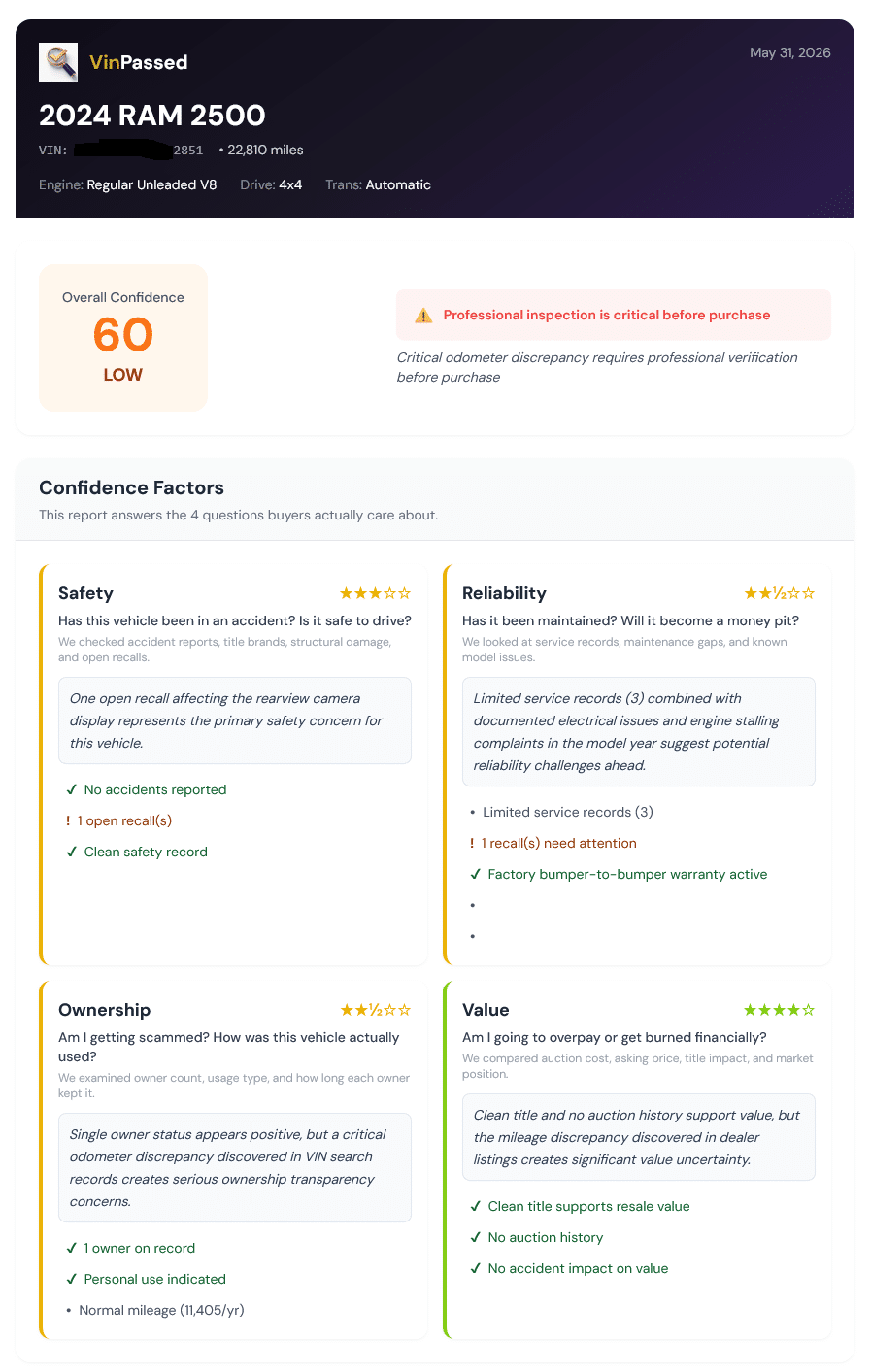
What "built-in analysis" actually means
Here's a way to see the difference clearly. Hand a generic chatbot a bare VIN and ask about the car. It'll find a few fragments, tell you the model sometimes has transmission trouble (or it won't, depending on what it happens to surface), and then it'll ask you for the history report, because it can't reach the accident records, title brands, auction history, valuation, or model-specific repair costs that live in licensed databases. Even once you hand it a report, it's limited to what you knew to give it, and it doesn't really know where to look next.
VinPassed starts from the opposite end. The data is already assembled, the parts a chatbot can't see, and the analysis knows exactly where to look because it was built for this one job. So instead of fishing, it tells you how much each finding moves the car's value, what to be careful of, and what to verify before you buy. You can choose to read that analysis in any of ten languages, selected at checkout. You stay in control. We give you the understanding of what the data means, not just the data.
See it on a real car
Two complete sample reports are public, no purchase required, and they show the synthesis better than any description can.
- A 2018 Dodge Charger that scores 42 out of 100. The report flags maintenance that should already have been done at its mileage, prices the model's known failure points, and lays the projected ownership cost against what the dealer is asking. It's the report doing forward-looking work on a car that looks fine in the photos.
- A 2015 Maserati Ghibli S Q4 that scores 36 out of 100. A desirable, good-looking luxury sedan whose compiled record, salvage title, theft recovery, structural damage, and roughly $25,900 in documented repair estimates against a low auction cost, tells a very different story than the listing photos do. No single line on the report is the point. The combination is.
In both cases the score isn't flattery, it's a warning, and that's exactly what a report built for the buyer should do.
The forward-looking part: what’s coming, not just what happened
Every other report is a rear-view mirror. It tells you what already happened to the car. VinPassed adds the windshield. Because the report carries model maintenance schedules and real repair-cost data, it can tell you what's about to happen and what it'll cost.
A concrete example: a car listed for sale sitting right before a major scheduled service, say a roughly $2,000 service interval coming due at 120,000 miles, is a fact you'd want before you negotiate, not after. The report flags which scheduled services should already have been done at the current mileage, lays out the next several with line items and cost ranges, and carries that forward even past the manufacturer's end-of-schedule for high-mileage cars. It pairs that with the model's documented failure points and their typical repair costs, so a recurring expensive issue isn't a surprise three months after you sign. AI in the wild will tend to soften these into "possible" maintenance. They aren't speculation. They're scheduled, documented events that should occur, or should already have occurred. That's leverage in your hands at the negotiating table. The report even assembles a short list of specific questions to ask the seller based on what it found.
How the reports compare
The core history is shared across the top providers, so the differences are in what each one adds and whether it interprets the result. This isn't a scorecard we assigned ourselves. It's just what's in and out of each report.
| Capability | VinPassed | Carfax | AutoCheck | VinAudit |
|---|---|---|---|---|
| Accident history | ✓ | ✓ | ✓ | Limited |
| Title records (all states) | ✓ | ✓ | ✓ | ✓ |
| Service records | ✓ | ✓ | Partial | ✗ |
| Theft records | ✓ | ✓ | ✓ | ✓ |
| Buyback guarantee | ✗ | ✓ (terms apply) | ✗ | ✗ |
| Full factory specs (MSRP + options) | ✓ | Basic | Basic | Basic |
| Market values (trade-in / private / dealer) | ✓ | ✗ | ✗ | ✗ |
| Actual model repair costs (real ranges) | ✓ | ✗ | ✗ | ✗ |
| Maintenance, searchable by mileage | ✓ | Partial | ✗ | ✗ |
| Forward-looking cost of ownership | ✓ | ✗ | ✗ | ✗ |
| NHTSA complaint + TSB summary | ✓ | ✗ | ✗ | ✗ |
| Single longevity / comparative score | ✓ | ✗ | ✓ AutoCheck Score | ✗ |
| Confidence score on 4 buyer questions (reasoning shown) | ✓ | ✗ | ✗ | ✗ |
| Included garage for full searchable data + documents | ✓ | ✗ | ✗ | ✗ |
| Everything compiled into one judgment on the car | ✓ | ✗ | ✗ | ✗ |
| Single report price | See pricing | $44.99 | ~$30 | ~$10 |
VinPassed Vehicle History Report
The full record, factory specs, market values, real repair costs, and forward-looking maintenance, compiled into one confidence score on the car you're looking at.
See current pricing. Reports never expire, and checks start at $5.
See pricing →How to actually choose
- A dealer offers a free Carfax? Take it, every time. Free data is free data. Just remember it was built as a sales tool, and that a low-cost report built for the buyer is a small check on a large purchase.
- Paying out of pocket and you want a real decision, not a printout? This is the case we built VinPassed for: the full record, the valuation, the repair costs, the forward-looking maintenance, all compiled into one score on the specific car.
- You only need a fast, cheap title/theft screen? The cheapest meaningful step beyond a free check is a $5 title and stolen check, and whatever you pay credits toward a full report if you decide to see more. VinAudit at around $10 is a legitimate alternative. Either rules out title problems quickly but won't give you valuation, repair-cost projections, or analysis.
- High-value purchase? It doesn't hurt to run a second report from a different provider. They pull from overlapping but not identical sources, and the discrepancies are sometimes where an important finding hides.
The garage keeps working after you buy
The included VinPassed Garage holds the full searchable data, and it's also an encrypted place to keep the documents that otherwise end up crumpled in a glovebox: insurance, registration, title, service receipts. Once you own the car, you can log your own maintenance there, with help adding third-party validation photos, and build the documented service record that's worth real money when you sell, since a car with proven maintenance commands more than one without. The document storage is free.
After you sign, the burden of proof is on you
One thing most buyers don't realize until it's too late. If something turns out to be wrong with the car, you're generally the one who has to prove it: that the dealer misrepresented it, that the defect existed at sale, that you were harmed. Recourse exists in many states, but it's far harder to invoke after the fact than to prevent with documentation beforehand. Exactly what protection you have varies a lot by state, and our state-by-state used car buyer protection guide lays out where you stand before you sign. (None of this is legal advice. It's a reason to know the car's full story before money changes hands.)
The honest bottom line
Carfax built the category and its history data is proven. Its weak spots are price, a dealer-first design, and a report that stops at the record, no values, no real repair costs, no full specs. AutoCheck is solid on history and cheaper, with a longevity score that's useful but was built for dealers buying at auction. VinAudit is a fine budget title screen. VinPassed carries the same core history all of them do, then adds the factory specs, market values, real repair costs, searchable maintenance, and TSB and complaint data they don't, and compiles every layer of it into one honest judgment about the car you're actually looking at. More data, and the analysis that tells you what it means. That combination is what makes a report the best one money can buy.
No report is a substitute for an inspection, and none can show what was never reported. But of the reports you can buy, pick the one that does the interpreting for you, the person handing over the money. See what's in a VinPassed report.
Frequently Asked Questions
Common questions about vehicle history reports: how they work, what they cover, and how to use them when buying a used car.
The major reports tie on core history (title, accident, theft, ownership) because they read the same sources. Beyond that they diverge, and the best report carries far more: full factory specs, market values, real repair costs, searchable maintenance, and NHTSA complaint and TSB data the others don't. Then it compiles all of it into a single judgment about the specific car, instead of handing you records to interpret yourself. That is what VinPassed is built to do: four buyer questions, one confidence score, with the reasoning shown.
Yes. VinPassed pulls the full vehicle record from the same core sources the established reports use, including state DMV records, NMVTIS, insurance submissions, and auction data. The difference is what it does with that data: it adds valuation, model-specific repair costs, forward-looking maintenance, and cost of ownership, then compiles all of it into one confidence score that answers the four questions a buyer has about the car. You can see a full example in the sample reports before you pay.
It resolves the entire report into the four questions a buyer actually asks: Is it safe? Will it be reliable? Was it owned and used honestly? Am I going to overpay? Each gets an understandable rating with the supporting facts shown, and a proprietary algorithm combines them into one overall score from 0 to 100. A low score on a bad car is the point. The report is built to talk you out of the wrong car, not to flatter every VIN.
On the core history, no single provider is meaningfully more accurate than the others, because they read the same sources: state DMV records, NMVTIS, insurance submissions, and auction data. So treat any "most accurate" claim skeptically. What actually varies is completeness and interpretation, whether a report adds market values, real repair costs, and forward-looking maintenance, and whether it tells you what the record means for the specific car. Accuracy is roughly shared; usefulness is not. For a high-value purchase, running two reports can surface the rare discrepancy between sources.
Take a free Carfax if a dealer offers one. If you're paying out of pocket and want a real buying decision, VinPassed carries the same core history plus factory specs, market values, real repair costs, and forward-looking maintenance, compiled into one confidence score on the car. If you only need a fast title and theft screen, a $5 check is the cheapest meaningful step beyond free. For a high-value purchase, running two reports from different providers doesn't hurt.
You can get some of it free. NHTSA covers open recalls and safety ratings, and NICB VINCheck covers theft and salvage flags, both at no cost. What no free source carries is individual accident history, title-brand detail, valuation, repair-cost projections, or the analysis that ties it together. A free VIN check is a legitimate first filter; a paid report is what tells you what the specific car's full record means.
Because a public chatbot doesn't have the data. It can explain what a VIN is and what a salvage title means in general, but it can't see this car's accident records, title brands, auction history, valuation, or model-specific repair costs, because those live in licensed databases it can't reach. VinPassed runs its analysis on top of that validated data, then assembles the result into a read on the specific vehicle. That's the part you can't get from a chatbot.
No. Every report, including ours, can only show what was reported to a database. Out-of-pocket repairs, damage before a dealer acquired the car, and reconditioning that hides condition can be invisible to any text-based report. A clean report means nothing problematic reached that provider's data, not that nothing happened. Pair any report with a professional pre-purchase inspection.
Free from a dealer, always take it. As a $44.99 out-of-pocket purchase it's harder to justify, because it was built as a dealer sales tool and shows you the record without telling you what the record means for your decision. Its one unique feature is the Buyback Guarantee, which covers only DMV-reported title brands missing from the report, not accidents or mechanical issues, and with restrictive terms. Read them before relying on it.
It estimates the likelihood a vehicle is still on the road in five years, benchmarked against similar vehicles of its class and age, factoring age, mileage, owners, accidents, and title events. Experian built it primarily as a dealer acquisition tool for fast auction decisions. It's a single longevity number. It doesn't address what the car is worth, what it will cost to own, or what maintenance is coming due. For a buyer it's a useful secondary screen, not a decision.
For core data they're close, since both pull from the same federal and insurance sources. Carfax has broader service records and the Buyback Guarantee; AutoCheck is cheaper and adds its longevity score. Both were built for the dealer side first. We break the head-to-head down in detail in Carfax vs AutoCheck.
It depends what you want Carfax to do. For the same core history at lower cost, AutoCheck and NMVTIS-direct providers cover it. For a report that actually interprets the car for a buyer rather than displaying records, that's the case VinPassed is built for. We compare the options in the best Carfax alternative.
Largely, for the core. Carfax, AutoCheck, VinPassed, and VinAudit all draw from state DMV records, NMVTIS, insurance submissions, and auction pipelines, so title, theft, accident, and ownership data is broadly comparable. They differ in what each adds on top, and in whether they hand you the records or compile them into a judgment about the car.
The National Motor Vehicle Title Information System. It was created under the federal Anti Car Theft Act of 1992, with responsibility moved to the U.S. Department of Justice in 1996. The DOJ is responsible for it and has contracted the American Association of Motor Vehicle Administrators (AAMVA) to operate it. Most states plus D.C. participate. Because it consolidates title-brand data across jurisdictions, an NMVTIS-sourced report can catch a branded title even if it was issued in a different state, which is the main defense against "title washing." It's accessible to consumers at vehiclehistory.bja.ojp.gov.
In 2026, from free to about $45 for a single report. Free NHTSA and NICB lookups cover recalls and basic theft flags only. The cheapest meaningful step beyond free is a title and stolen check, which starts at $5 with VinPassed and credits toward a full report if you upgrade. AutoCheck's full report is about $30, Carfax is $44.99, and VinPassed's full report and multi-report pricing is on the pricing page.
For a high-value purchase, it doesn't hurt. Providers pull from overlapping but not identical sources, and the discrepancies between two reports are sometimes where an important finding appears. At minimum, never rely solely on a dealer-provided report, since it was chosen to help sell the car.
They vary significantly by state, and the burden is generally on you to prove misrepresentation or a pre-existing defect. Some states have strong UDAP statutes with attorney fees and damages; others permit as-is sales with little recourse. Knowing your state's protections, and documenting the car's history, before you sign matters far more than trying to act afterward. See our state-by-state used car buyer protection guide. This isn't legal advice.
Disclosure: we build VinPassed, one of the reports compared here, so read this as our argument rather than a neutral lab test. We've kept every factual claim sourced and checkable, and you can see two complete VinPassed reports yourself, linked above, before deciding whether we're right.